
Kabaddi Tournament Management - Pro Kabaddi Style for Local Leagues

Pro Kabaddi Changed Everything
Before 2014, kabaddi tournaments in India were largely village affairs - exciting, chaotic, and completely unstructured. Then Pro Kabaddi League launched and did for kabaddi what the IPL did for cricket: turned a traditional sport into a television spectacle. Suddenly, kabaddi had team owners, auction drafts, instant replays, and prime-time TV slots.
The ripple effect at the grassroots level has been enormous. District and club-level kabaddi tournaments across Maharashtra, Haryana, Tamil Nadu, and Telangana now aspire to replicate the PKL experience. Players want structured formats, proper scoring, team jerseys, and match-day production. Organizers who deliver this draw bigger crowds, better players, and more sponsorship.
Format Options for Local Kabaddi Tournaments
Standard League Format (PKL Style)
Best for 6-10 teams. Each team plays every other team once. Top 4 qualify for semifinals. This is the closest to the Pro Kabaddi format and works well for events spread across multiple weekends.
For a league with 8 teams: 28 league matches + 2 semifinals + 1 final = 31 matches. At 3 matches per day on one mat, that is roughly 10-11 days. For weekend-only events, plan for 5-6 weekends.
Group Stage + Knockout
Best for 12-24 teams. Divide into groups of 4-6, play round robin within groups, top 2 per group advance to knockout. This is the most practical format for single-day or two-day tournaments.
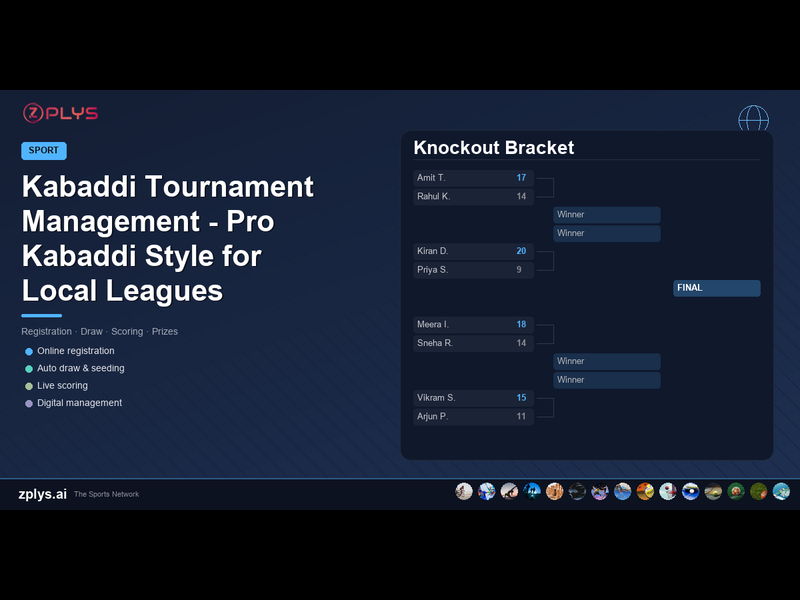
Knockout
Best for 16-32 teams when time is limited. Simple, dramatic, but harsh - one bad game and you are out. Use this for larger fields where a league format is logistically impossible.
Scoring and Match Rules
For local tournaments, adapting Pro Kabaddi rules with minor modifications works best:
- ●**Match duration:** Two halves of 15-20 minutes each (PKL uses 20 minutes). For large tournaments with many matches, 15-minute halves keep the schedule manageable.
- ●**Team size:** 7 players on the mat, 5 substitutes. Total squad of 12 is standard.
- ●**Raid clock:** 30 seconds per raid (same as PKL). Without a raid clock, raids drag on and matches lose momentum. Use a visible countdown timer - even a phone timer projected on a screen works.
- ●**Super raid bonus:** Optional but exciting. A raider who touches 3 or more defenders earns a super raid bonus of 1 additional point. This encourages aggressive raiding.
- ●**All out rule:** When all players on a team are out, the opposing team gets 2 bonus points and all players are revived. This keeps matches competitive even when one team dominates.
Team Registration and Management
Player Registration
Each team should submit a squad list of 12 players with:
- ●Full name and photo
- ●Age and weight category (if applicable)
- ●Aadhaar or school ID for verification
- ●Playing position (raider, defender, all-rounder)
For village-level tournaments where players may not have formal IDs, be flexible. A reference from a known community member works. The goal is participation, not bureaucracy.
Auction Format (For Franchise Leagues)
The PKL auction format has become incredibly popular for local leagues, especially in Haryana, Maharashtra, and Karnataka. Here is how it works at the grassroots level:
- All registered players go into a common pool
- Team owners or captains are given a budget (typically Rs 50,000-2,00,000 in notional currency)
- Players are auctioned one by one with a base price based on their category (raiders typically have higher base prices)
- Bidding continues until only one bidder remains
Running a smooth auction requires a proper auction management system. Platforms like Zplys offer auction modules with real-time bidding, automatic budget tracking, and even overlay graphics if you want to stream the auction. A 60-player auction should take 90-120 minutes with proper software.
The Mat and Venue
Mat Specifications
A standard kabaddi mat is 13 x 10 meters with clear boundary lines, a center line, baulk lines, and bonus lines. For local tournaments:
- ●**Outdoor on mud:** Traditional and still common in rural tournaments across Punjab, Haryana, and Maharashtra. Mark lines with chalk or lime. Ensure the surface is level and free of stones.
- ●**Indoor on mats:** Tatami or wrestling mats work well. A proper kabaddi mat costs Rs 1,50,000-3,00,000 to purchase, but rental options are available in most cities for Rs 5,000-15,000 per day.
- ●**Synthetic surface:** Schools and sports complexes increasingly have synthetic courts that work for kabaddi with proper line markings.
Venue Requirements
- ●Minimum playing area of 17 x 14 meters (mat plus safety zone)
- ●Seating or standing area for spectators
- ●Changing rooms for teams
- ●First aid station (kabaddi is a contact sport - sprains, cuts, and bruises are common)
- ●Sound system for announcements and music (atmosphere matters in kabaddi)
Creating the PKL Atmosphere
What makes Pro Kabaddi thrilling is not just the sport - it is the production. Local organizers can replicate key elements:
- ●**Music and announcements:** Play music during breaks. Have an MC who announces raids, super tackles, and all outs with energy. This single addition transforms the atmosphere more than anything else.
- ●**Team colors:** Insist on distinct jersey colors for each team. Avoid similar shades (light blue vs. dark blue causes confusion on the mat).
- ●**Scoreboard display:** A visible scoreboard - even a TV screen connected to a laptop - lets spectators follow the match. Live scoring through a platform eliminates the need for manual scoreboards.
- ●**Photography and video:** Kabaddi produces spectacular action shots - raiders flying through the air, ankle holds, chain tackles. Capture these. They are your marketing material for the next edition.
Refereeing
Kabaddi refereeing requires specific knowledge. You need:
- ●1 referee and 1 umpire per match (minimum)
- ●1 scorer
- ●1 timekeeper
For tournaments above local village level, invest in trained referees. The Amateur Kabaddi Federation of India (AKFI) conducts refereeing courses, and many state associations have panels of certified referees available for Rs 1,500-3,000 per day.
Common refereeing challenges in local kabaddi:
- ●**The cant rule:** The raider must continuously chant kabaddi without breaking breath. Enforcing this consistently is difficult and controversial. Use the 30-second raid clock as the primary timer and the cant as a secondary check.
- ●**Touch vs. no touch disputes:** These are the kabaddi equivalent of cricket's DRS. Without video replays, the referee's decision must be final. Establish this clearly in pre-tournament meetings.
- ●**Lobby rule:** Players entering the lobby area before contact is made are out. This rule is frequently misunderstood. Brief all teams during the captains' meeting.
Budgeting for a Local Kabaddi Tournament
Realistic budget for an 8-team, 2-day tournament in a tier-2 city:
- ●Mat rental: Rs 10,000-15,000
- ●Venue rental: Rs 5,000-20,000
- ●Referees (2 per day): Rs 6,000-12,000
- ●Prizes and trophies: Rs 15,000-50,000
- ●Sound system and MC: Rs 3,000-8,000
- ●First aid and medical: Rs 2,000-5,000
- ●Photography: Rs 5,000-8,000
- ●Miscellaneous (water, printing, transport): Rs 5,000-10,000
Total: Rs 51,000-1,28,000. With entry fees of Rs 3,000-5,000 per team, an 8-team tournament generates Rs 24,000-40,000 from registrations alone. The gap is typically covered by local sponsorship - a surprisingly easy sell for kabaddi in states where the sport has a passionate following.