
How to Run a Basketball Tournament in India

Basketball in India Is Bigger Than You Think
India has an estimated 2-3 million active basketball players, and the number is growing steadily. The NBA Academy India in Greater Noida, state-level leagues in Tamil Nadu and Punjab, and the rising popularity of 3x3 basketball in cities like Bengaluru and Mumbai have created a genuine basketball ecosystem. Yet most basketball events in India are still organized with the same methods used 20 years ago - paper brackets, manual scheduling, and WhatsApp chaos.
Whether you are running a school inter-house tournament, a corporate 3x3 event, or a city-level 5v5 league, here is how to do it properly.
Choosing Your Format - 5v5 vs. 3x3
Full Court 5v5
The traditional format. Four quarters of 10 minutes each (FIBA rules) or 8 minutes (for amateur and school events). Requires a full court (28 x 15 meters), two hoops, and a minimum of 10 players per team.
Best for: School and college tournaments, state-level competitions, events where teams are established and rosters are fixed.
Scheduling consideration: A 5v5 game takes 50-70 minutes including stoppages. On one court, you can fit 6-7 games per day (8 AM to 6 PM). An 8-team knockout requires 7 games - a comfortable one-day event on a single court.
3x3 Half Court
The format that is transforming basketball globally. Three players per team, half court, 10-minute games or first to 21 points. Fast, intense, and requires minimal infrastructure - one hoop and a half court.
Best for: Corporate events, community tournaments, events targeting casual players, venues with limited space. A single half court can host 3-4 games per hour.
The 3x3 format is exploding in Indian metros. A corporate 3x3 tournament in Bengaluru or Gurugram can attract 20-30 teams with minimal promotion because the format is accessible - you only need 3 friends who can play, not a full 12-person roster.
Court and Venue Requirements
Indoor Courts
Preferred for competitive events. Wooden or synthetic floors provide consistent bounce and reduce injury risk. Indoor courts in India are available at:
- ●School and college gymnasiums (Rs 2,000-5,000/hour)
- ●Sports complexes and stadiums (Rs 3,000-10,000/hour)
- ●Private sports facilities (Rs 5,000-15,000/hour)
Book well in advance - indoor basketball courts are scarce in most Indian cities and get booked quickly.
Outdoor Courts
More accessible and cheaper, but weather-dependent. Concrete outdoor courts at public parks and community centres are the most common basketball venues in India. Considerations:
- ●Surface must be level and crack-free (uneven concrete is an ankle injury waiting to happen)
- ●Have a backup rain plan (even if it is just postponing by a day)
- ●Start early (6 AM) during summer months - playing basketball on concrete at noon in Chennai is dangerous
- ●Ensure proper hoop height (10 feet for adults, 8.5 feet for under-12, 9 feet for under-14)
Registration and Team Management
Basketball registration is team-based, which adds complexity compared to individual sports:
- ●**Roster submission:** Each team submits a roster of 10-12 players (5v5) or 4-6 players (3x3) with jersey numbers
- ●**Age verification:** For age-group tournaments, collect date of birth and ID proof. In school tournaments, a school-issued bonafide certificate is standard.
- ●**Photo ID:** Each player needs a recent photo for the scoretable to verify identity during games
A digital registration system makes this dramatically easier. On platforms like Zplys, team captains register the team, add players with photos and jersey numbers, and pay entry fees in one flow. No more collecting 12 passport photos and a handwritten roster form.
Entry fees for basketball tournaments in India (2026):
- ●School tournaments: Rs 500-1,500 per team
- ●Open amateur 5v5: Rs 2,000-5,000 per team
- ●3x3 corporate/community: Rs 1,000-2,500 per team
- ●Premium events with cash prizes: Rs 5,000-10,000 per team
Scheduling and Draw Creation
Group Stage + Knockout (Recommended for 8-16 Teams)
Divide teams into groups of 4. Each group plays a round robin (6 games per group). Top 2 from each group advance to knockout. For 12 teams in 3 groups: 18 group games + 4 knockout games = 22 games. On 2 courts, that is a comfortable 2-day event.
Single Elimination (For 16+ Teams or Time Constraints)
Simple bracket. Seed the top 4-8 teams based on registration order, previous results, or organizer knowledge. A 16-team bracket requires 15 games - doable in one day on 2 courts.
Scheduling Tips Specific to Basketball
- ●Allow 15-20 minutes between games for warmups and court changeover
- ●Never schedule a team for back-to-back games without at least 90 minutes rest
- ●Put the best matchups in the evening when crowds are largest (especially for outdoor events)
- ●Publish the complete schedule at least 3 days before the event and send it via WhatsApp
Game-Day Operations
Officials
- ●2 referees per game (3 for finals)
- ●1 scorer
- ●1 timekeeper
- ●1 shot clock operator (if available - for serious competitions)
Referee fees in India: Rs 500-1,500 per game for district-level certified referees. For a 2-day tournament with 20 games, budget Rs 10,000-30,000 for officiating.
Scorekeeping
Manual scorekeeping on a physical scoresheet is still common at grassroots level in India, but digital scoring is dramatically better. Real-time score updates mean that teams waiting for their game can follow current matches. Parents and fans who are not at the venue can track results.
Game Equipment Checklist
- ●Basketballs: 2-3 game balls (Molten or Spalding, Rs 2,500-5,000 each) plus 4-6 warmup balls
- ●Shot clock (optional but recommended): Portable shot clocks available for Rs 15,000-30,000
- ●Scoreboard: At minimum, a flip scoreboard (Rs 500-1,000). Ideally, a digital display.
- ●First aid kit with ice packs (basketball has the highest rate of ankle injuries among court sports)
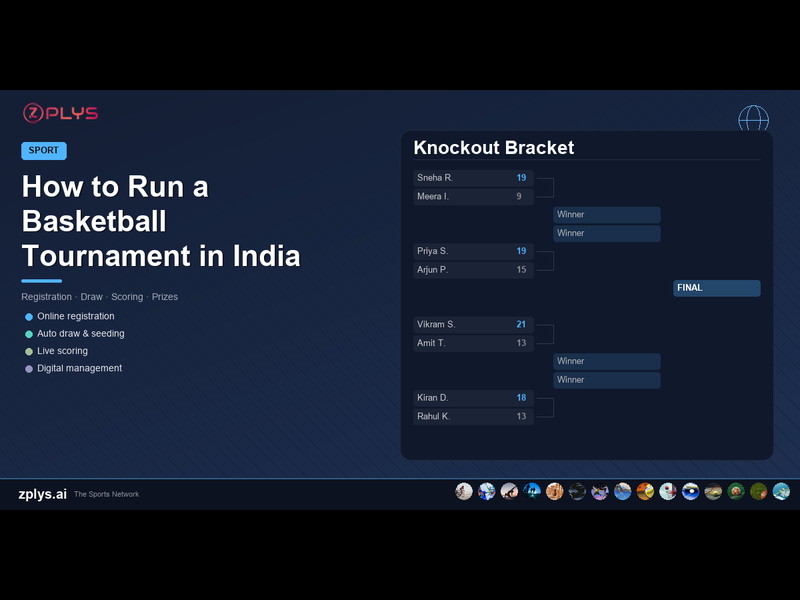
- ●Printed brackets displayed prominently at the venue
Growing Basketball Through Your Tournament
Every well-run basketball tournament grows the sport in its city. Some strategies:
- ●**Skills contest alongside the main tournament:** 3-point shooting contest, slam dunk competition (if you have the talent pool), and free throw challenge. These are easy to organize, fun for spectators, and engage players who may have been eliminated.
- ●**Beginner-friendly category:** A recreational division where teams can have maximum 2 experienced players ensures new players get competitive games, not 80-20 blowouts.
- ●**Youth clinics:** Run a 1-hour basketball clinic for kids during tournament breaks. It costs almost nothing (use tournament volunteers as coaches) and introduces the next generation to the sport.
- ●**Content and streaming:** A phone on a tripod live-streaming the semifinal on Instagram Live costs nothing and reaches people who might register for the next edition.
Basketball in India is at an inflection point. The infrastructure is still limited, the talent pool is growing, and the demand for organized competitive play is outstripping supply. If you can run a well-organized, professional-feeling basketball tournament, you will build a loyal player base that returns season after season.