
Hockey Tournament Organization - Field Hockey in Indian Schools

Field Hockey Deserves Better Organization
India has won 8 Olympic gold medals in hockey - more than any other country. Yet the grassroots organization of hockey tournaments in Indian schools and clubs remains shockingly informal. A sport with this kind of heritage deserves better than chalked-out fields, borrowed sticks, and brackets drawn on a chalkboard.
The good news is that Hockey India has been investing heavily in grassroots development. The Hockey India League, Khelo India, and state-level academies have created a pipeline of young players who want more competitive opportunities. If you are organizing hockey tournaments in schools, clubs, or at the district level, here is how to make them count.
Understanding the Playing Formats
Full Field 11-a-Side
The traditional format. 11 players per side on a full-size field (91.4 x 55 meters). Four quarters of 15 minutes each (senior level) or 10-12 minutes (school level). Requires a regulation-size field, preferably on astroturf, with proper goals, circles, and markings.
Realistic for: Schools with proper grounds, state and national level competitions, clubs with astroturf facilities.
Not realistic for: Most school tournaments (very few Indian schools have regulation hockey fields), weekend events with limited space.
6-a-Side Hockey
The format that is making hockey accessible at the grassroots level. Six players per side on a half-field (approximately 55 x 40 meters). Shorter matches (two halves of 10-12 minutes), faster pace, more goal-scoring opportunities.
This is the format Hockey India promotes for school-level introductory tournaments. It requires less space, fewer players per team, and produces high-scoring, exciting matches that keep young players engaged.
Indoor Hockey
Six players per side on a smaller indoor court (40 x 20 meters). Played with a heavier ball and modified rules (no hitting, only push and flick). Growing in metros where indoor sports facilities are available but outdoor field space is scarce.
Ground Preparation
Astroturf (Ideal)
Astroturf is the standard playing surface for competitive hockey globally. India has been installing astroturf pitches at an increasing rate - major cities have multiple facilities, and Khelo India has funded installations at state-level sports complexes.
Astroturf rental for tournament use: Rs 5,000-15,000 per day depending on the facility. Most facilities include basic goal posts and field markings. Book well in advance - astroturf pitches are shared between hockey, football, and sometimes cricket.
Natural Grass
Still the most common surface for school hockey in India. Prepare the ground properly:
- ●Mow the grass short (3-4 cm maximum) - long grass kills ball speed and makes dribbling nearly impossible
- ●Mark all lines clearly with white chalk or paint: sidelines, goal lines, circles (14.63m radius from the center of each goal), penalty spot (6.4m from goal)
- ●Fill any divots or uneven patches - a hockey ball bouncing unpredictably on an uneven field is dangerous
- ●Water the field before play if it is dry and dusty - this speeds up the surface and reduces dust
Hard Court / Concrete
Acceptable for introductory sessions and casual events but not ideal for competitive play. The ball bounces excessively and surface injuries (scrapes and burns from falls) are common. Use a slower ball on hard surfaces.
Tournament Structure
For School Tournaments (8-12 Teams)
Group stage + knockout works best. Divide teams into 2-3 groups of 4, play round robin within groups, top 2 advance to semifinals.
Match duration for school levels:
- ●Under-12: Two halves of 8 minutes each
- ●Under-14: Two halves of 10 minutes each
- ●Under-16: Two halves of 12 minutes each
- ●Under-18: Two halves of 15 minutes each
With 8-minute halves and 5-minute breaks, a match slot is about 25 minutes. On one field, you can fit 10-12 matches per day. A 12-team tournament needs about 19 matches (12 group + 4 quarters + 2 semis + 1 final) - a comfortable 2-day event.
For Club and District Level (16-24 Teams)
League format across 2-3 weeks (weekend matches) or a concentrated 3-4 day tournament. Pool play into knockout. Consider having a plate or consolation bracket so eliminated teams still have matches to play - critical for development tournaments where every match is a learning opportunity.
Equipment Requirements
Essential Equipment Per Team
- ●Hockey sticks: Each player brings their own (but have 4-5 spare sticks in different sizes for emergencies). Stick sizes: 28-32 inches for under-12, 34-36 inches for under-14/16, 36.5 inches for senior.
- ●Shin guards: Mandatory. No exceptions. A hockey ball traveling at speed causes serious injury to unprotected shins.
- ●Mouthguards: Increasingly mandated at all levels. Available for Rs 100-300 each.
- ●Goalkeeper kit: Full kit including leg guards, kickers, gloves, chest guard, helmet with face cage, and throat protector. A complete GK kit costs Rs 15,000-50,000. For school tournaments, maintain 2-3 shared GK kits.
Tournament Equipment
- ●Goals: Regulation size 3.66 x 2.14 meters. Portable aluminum goals cost Rs 25,000-60,000 per pair. Many schools build permanent goals - ensure they are properly anchored.
- ●Balls: 6-8 match balls (white for grass, yellow for astroturf). Budget Rs 500-1,200 per ball depending on quality.
- ●Cones and markers for training and warmup areas
- ●First aid kit with ice packs, bandages, and antiseptic (hockey produces bruises, cuts, and the occasional dental injury)
Umpiring
Hockey requires 2 umpires per match, each controlling one half of the field. Key responsibilities:
- ●Awarding penalty corners and penalty strokes
- ●Calling dangerous play (raised ball, stick above shoulder height, physical contact)
- ●Managing the sin bin (temporary suspensions shown by green, yellow, and red cards)
Umpire development is one of the biggest challenges in Indian grassroots hockey. The shortage of trained umpires means that school tournaments often have PE teachers or senior students umpiring - which leads to inconsistent officiating and player frustration.
Solutions:
- ●Contact your state hockey association for a panel of umpires. Fees: Rs 800-2,000 per match for certified umpires.
- ●Run a 2-hour umpiring workshop before the tournament for volunteer umpires. Hockey India provides free umpiring resources.
- ●For school-level play, simplify the rules - no penalty corners (use long corners instead), no offside, and simpler card system. This makes umpiring manageable for non-specialists.
Safety Considerations
Hockey has a higher injury rate than most school sports. Take safety seriously:
- ●**Mandatory protective equipment.** No shin guards, no play. Period.
- ●**Dangerous play rules.** Enforce the raised ball rule strictly at junior levels. A ball raised above knee height in the circle is immediately dangerous.
- ●**Warm-up area separation.** Teams warming up with sticks and balls near the playing field is a common source of injuries. Designate a separate warmup area.
- ●**Medical support.** Have a first aid volunteer at every match. For district-level and above, a physiotherapist or sports medicine professional on call is recommended.
- ●**Hydration.** Quarter breaks exist for a reason. Ensure water is available courtside, especially for junior players who forget to hydrate.
Using Technology for Hockey Tournaments
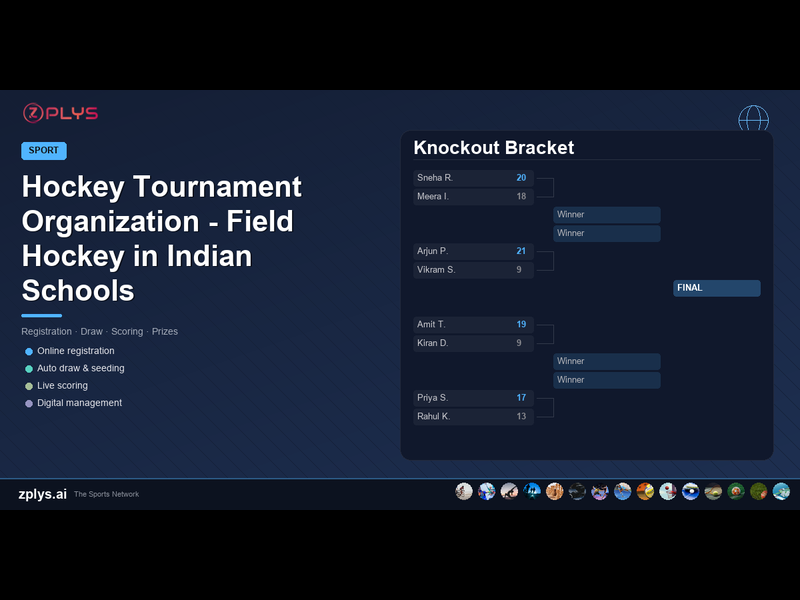
Digital tournament management transforms the hockey experience. Online registration with team rosters and player photos (for identity verification), automated draw generation, digital match scheduling, and live scoring all apply to hockey the same way they do to any team sport. Platforms like Zplys handle these mechanics regardless of the sport, so a hockey organizer gets the same registration, communication, and scoring infrastructure as a cricket or football tournament.
The specific advantage for hockey is stat tracking: goals, assists, penalty corner conversions, cards. When these stats are recorded digitally per match, you build a database that helps coaches track player development and helps selectors identify talent objectively rather than relying solely on who they happen to watch.