
Fee Collection for Sports Academies - Stop Losing Money to Manual Processes

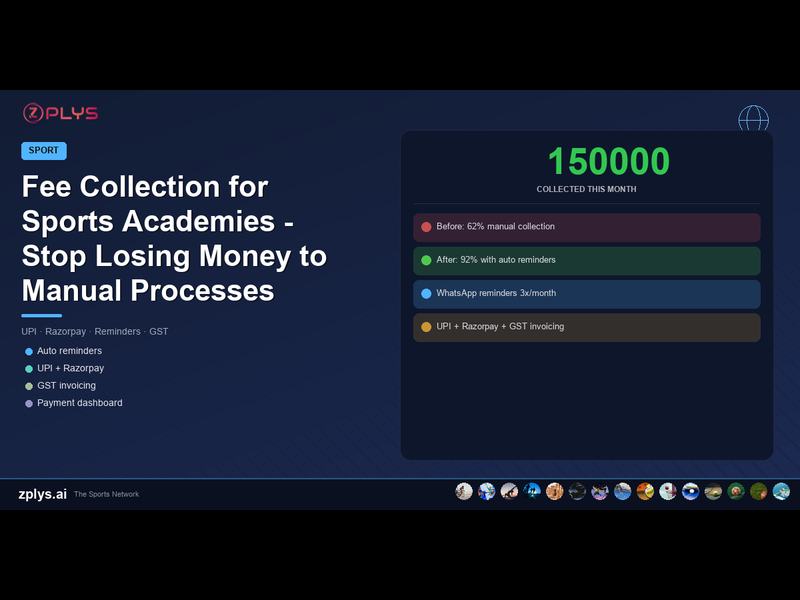
A badminton academy in Bangalore with 180 students should collect Rs 7.2 lakh per month at an average fee of Rs 4,000. Their actual monthly collection? Rs 5.6 lakh. The missing Rs 1.6 lakh is not from students who dropped out. It is from students who are actively training but whose parents have not paid - some for two months, some for three.
This is not an unusual story. It is the norm across Indian sports academies. When we asked coaching centre owners what percentage of fees they collect on time, the average answer was 68%. That means nearly a third of revenue is perpetually delayed.
Why Manual Fee Collection Fails
The problem is not that parents refuse to pay. Most parents are willing. The system - or lack of one - creates the gap.
With manual tracking, here is what typically happens: the coach marks attendance and sometimes asks about fees. The parent says "I'll pay this weekend." The coach forgets to follow up. Three weeks pass. Now it is awkward to ask because the delay has grown. The coach compensates by avoiding the conversation. The parent, hearing nothing, assumes it is fine to pay whenever.
Multiply this across 150 students and 6 batches, and you have a coach who spends 30% of their mental energy worrying about money instead of coaching.
The Three Pillars of Reliable Fee Collection
1. Automated Reminders
The single most impactful change you can make. Set up automatic WhatsApp messages that go out:
- ●3 days before the due date: "Hi [Parent Name], [Student Name]'s fee of Rs [Amount] for [Month] is due on [Date]. Pay here: [Link]"
- ●On the due date: "Reminder: [Student Name]'s fee is due today."
- ●3 days after: "[Student Name]'s fee of Rs [Amount] is overdue. Please clear the balance to continue training."
These messages are not rude. They are factual. And they work because they remove the human awkwardness from the process. A swimming academy in Chennai automated their reminders and saw overdue fees drop from Rs 4.2 lakh to Rs 80,000 within two billing cycles.
2. Online Payment Links
Every reminder should include a payment link. UPI payment links through Razorpay or similar gateways let parents pay in 10 seconds flat. No cash, no cheques, no "I'll bring it tomorrow."
The payment gateway charges 1.5-2% per transaction. On a Rs 4,000 fee, that is Rs 60-80. Academy owners sometimes resist this cost, but consider: if automated payments improve your collection rate from 68% to 92%, you are collecting Rs 24,000 more per 100 students per month. The gateway fee on that is Rs 360-480. The math is not even close.
3. Real-Time Payment Dashboard
You need to see, at a glance, who has paid and who has not. A dashboard that shows: total expected this month, total collected, total overdue, and a list of students with outstanding balances sorted by amount and days overdue.
This replaces the mental gymnastics of trying to remember who paid and who did not. It also helps when you need to make decisions - like whether to allow a student with three months of unpaid fees to continue training.
Setting Up Your Fee Structure
Before automating collection, get your fee structure right:
- ●Monthly billing on a fixed date (1st or 15th works best - avoid mid-month dates that parents forget)
- ●Clear late payment policy: "Fees unpaid by the 10th incur a Rs 200 late charge." Communicate this in writing at enrollment. Most parents will pay on time just to avoid the charge, even if you rarely enforce it.
- ●Offer quarterly and annual plans with a discount (5-10% off). This locks in revenue and reduces your monthly collection burden. A football academy in Noida moved 40% of their students to quarterly billing and reduced their monthly unpaid balance by half.
- ●Registration fee (one-time): Rs 500-2,000. This covers your admin cost and creates a commitment signal.
GST Compliance for Academies
If your annual revenue exceeds Rs 20 lakh (Rs 10 lakh in special category states), GST registration is mandatory. Sports coaching is taxed at 18% GST.
What this means practically: if you charge Rs 4,000/month, Rs 610 of that is GST that you must remit. You can either include GST in your fee ("Rs 4,000 inclusive of GST") or add it on top ("Rs 4,000 + 18% GST = Rs 4,720"). Most academies include it to keep the headline number clean.
Your management software should generate GST-compliant invoices automatically. If it does not, you are creating extra work for your accountant every quarter.
The Technology Stack
A complete fee collection setup for an Indian sports academy needs:
- ●Management platform with automated reminders (Zplys, or similar)
- ●Payment gateway (Razorpay or Cashfree - both support UPI, cards, and net banking)
- ●WhatsApp Business API for reminders (most platforms include this)
- ●GST-compliant invoicing (should be built into your platform)
Total cost: Rs 999-2,500/month for the platform + 1.5-2% per payment transaction. Against the revenue recovered from improved collections, this pays for itself within the first billing cycle.
What Good Looks Like
An academy with healthy fee collection has these numbers: 90%+ on-time payment rate, average overdue balance under 5% of monthly billing, zero fees outstanding beyond 60 days (because they have a policy and enforce it), and less than 30 minutes per week spent on fee-related admin.
That last point matters most. You started an academy to coach, not to chase payments. The right systems let you get back to what you are good at.