
Chess Tournament Organization - Swiss, Round Robin, and Online

Chess Tournaments in India - A Unique Organizational Challenge
India has an estimated 30 million chess players and produces more grandmasters than almost any other country. From school-level inter-house tournaments in Tier-3 cities to FIDE-rated open events in Chennai, chess tournaments are happening somewhere in India every single day. Yet the organizational side remains stuck in the 1990s for most events - manual Swiss pairings done by an arbiter with a spreadsheet, handwritten scorecards, and results posted on a physical noticeboard.
Chess tournaments are fundamentally different from most sports events in ways that affect organization:
- ●A single game can last 15 minutes (rapid) or 6 hours (classical)
- ●The number of participants can range from 20 to 2,000+
- ●Pairing algorithms are mathematically complex (Swiss system)
- ●Silence and concentration are required during play
- ●FIDE rating implications add a layer of administrative complexity
Format Selection - Know Your Options
Round Robin
Every player plays every other player once. Best for small, elite groups of 6-12 players. A 10-player round robin requires 9 rounds with 5 games per round - 45 total games. This is the most fair format but becomes impractical above 14 players (13 rounds needed).
Used for: Club championships, inter-school finals, coaching academy internal tournaments, qualification events with small pools.
Swiss System
The format that makes large chess tournaments possible. Players are paired in each round based on their current score - winners play winners, losers play losers. After 6-9 rounds, the player with the most points wins. A 200-player tournament needs only 7-8 rounds to determine a clear winner, compared to 199 rounds for a full round robin.
Used for: Open tournaments, school championships, FIDE-rated events, any tournament with 20+ players.
Key Swiss system rules that organizers must understand:
- ●**Color alternation:** Players should alternate between white and black as much as possible. A player should never have the same color three times in a row.
- ●**Score groups:** Players with the same score are paired against each other whenever possible.
- ●**No repeat pairings:** Two players cannot face each other twice in the same tournament.
- ●**Rating-based seeding:** Within a score group, higher-rated players are paired against mid-rated players, not each other.
Knockout
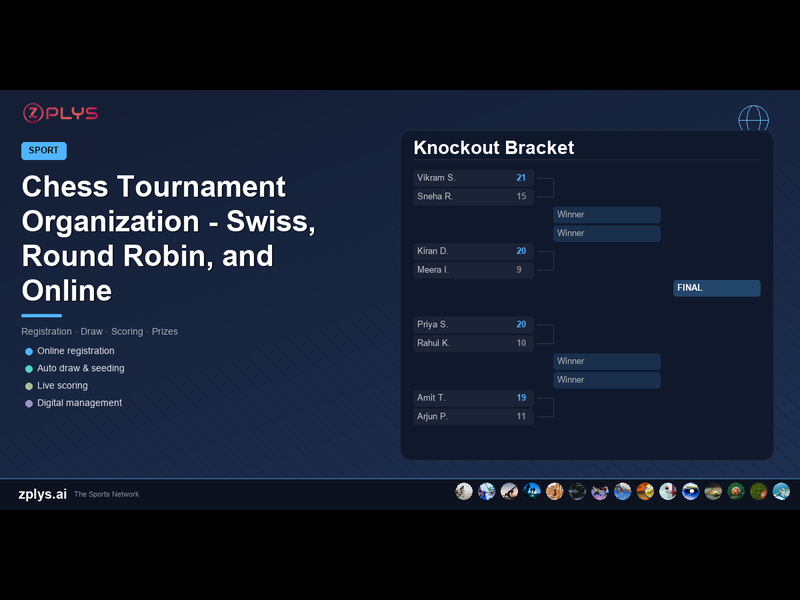
Two-game mini-matches (one white, one black) with tiebreaks. Dramatic but requires an even number of players and eliminates half the field every round. Used primarily for invitational events or final stages of large tournaments.
Pairing Software - Do Not Do This Manually
Swiss pairings by hand are error-prone and time-consuming. For any tournament with more than 16 players, use pairing software:
- ●**Swiss Manager:** The most widely used pairing software in India. Licensed software (Rs 5,000-15,000 depending on the version). Handles FIDE-rated and non-rated events. Generates pairings, standings, and rating reports.
- ●**Tornelo:** Online platform that handles both over-the-board and online tournaments. Free for basic use.
- ●**Chess-Results.com:** A free web-based system used for many Indian tournaments. Simpler than Swiss Manager but adequate for club-level events.
For registration and event management beyond pairings, platforms like Zplys can handle player registration, fee collection, and communication, while a dedicated chess pairing tool handles the round-by-round pairings.
Venue Requirements - Chess Is Different
Chess has specific venue needs that differ from every other sport:
- ●**Silence:** The playing hall must be quiet. No adjacent rooms with loud events. No street noise. Air conditioning is preferred over fans (ceiling fans create distracting shadows on the boards).
- ●**Lighting:** Even, bright lighting across all boards. No spotty fluorescent tubes that flicker. Natural light is ideal but avoid direct sunlight hitting boards (glare makes it impossible to see pieces).
- ●**Space:** Each board needs a minimum of 1.5 x 0.8 meters of table space. Chairs should be comfortable for long games. A 100-board tournament needs a hall that can accommodate 50 tables with adequate spacing.
- ●**Clocks:** Every board needs a chess clock. Digital clocks (Rs 1,500-3,000 each) are standard. For a 100-player tournament, you need 50 clocks. Many organizers ask players to bring their own and provide extras.
- ●**Sets and boards:** Standard Staunton pieces and vinyl boards are fine for non-FIDE events. A set costs Rs 200-500. Wooden pieces and wooden boards (Rs 1,500-5,000 per set) are needed for FIDE-rated events.
Running the Event - Round by Round
Pre-Tournament
- Close registration 24-48 hours before. Late entries disrupt Swiss pairings.
- Verify player identities and FIDE IDs (for rated events).
- Publish the starting rank list based on ratings.
- Conduct the technical meeting - time control, rules about mobile phones (strict ban during games), appeal procedures.
During Each Round
- Generate and post pairings 15-30 minutes before the round starts.
- Players find their board number and sit down.
- Arbiter starts all clocks simultaneously.
- Games proceed. The arbiter monitors for rule violations (illegal moves, mobile phone use, excessive noise).
- As games finish, results are recorded. When all games in the round are complete, the next round pairing is generated.
Time Between Rounds
This is where chess tournament logistics get tricky. If the time control is 30 minutes per player (rapid), rounds take about 60-70 minutes. You can schedule 6-7 rounds in a day with 15-minute gaps.
For longer time controls (60 minutes per player), a round can take over 2 hours. Plan for 3-4 rounds per day maximum, or spread the tournament across two days.
Common Organizational Challenges
The Bye Problem
When you have an odd number of players, one player gets a bye (free point) each round. In Swiss system, the lowest-ranked player in the lowest score group gets the bye. Communicate this clearly - players sometimes feel cheated when they receive a bye, not understanding it is a standard procedure.
The Withdrawal Problem
Players who withdraw mid-tournament disrupt pairings. Their opponents in future rounds lose a meaningful game. Minimize this by:
- ●Requiring pre-tournament commitment to play all rounds
- ●Charging a registration fee that is non-refundable for mid-tournament withdrawals
- ●Having a reserve list of players who can be inserted if someone withdraws before round 2
The Dispute
Chess disputes usually involve: whether a move was made before the flag fell, whether an illegal move occurred, or claims of external assistance (phone use). The arbiter's decision should be final for the tournament. For FIDE-rated events, an appeals committee is required.
Budgeting
A 100-player Swiss tournament (6 rounds, rapid time control, one day):
- ●Venue: Rs 5,000-15,000
- ●Chess sets and boards (50): Rs 10,000-25,000 (one-time investment, reusable)
- ●Clocks (50): Rs 75,000-1,50,000 (one-time investment - this is the biggest cost)
- ●Arbiter fees: Rs 3,000-8,000
- ●Prizes: Rs 10,000-50,000
- ●Software: Rs 0-5,000
- ●Printing and miscellaneous: Rs 2,000-5,000
Entry fees of Rs 200-500 per player generate Rs 20,000-50,000. The biggest barrier is the upfront clock investment, which is why many organizers start with rapid events where players bring their own clocks, and gradually build an inventory.
Online Chess Tournaments
Post-pandemic, online chess is a permanent fixture. Platforms like Chess.com and Lichess handle the playing, but organizer responsibilities remain: registration, communication, anti-cheating monitoring, and prize distribution. Use a tournament management platform for registration and a playing platform for the actual games. This hybrid approach gives you the best of both worlds.