
Tournament Scheduling and Fixture Management - Avoid the Chaos

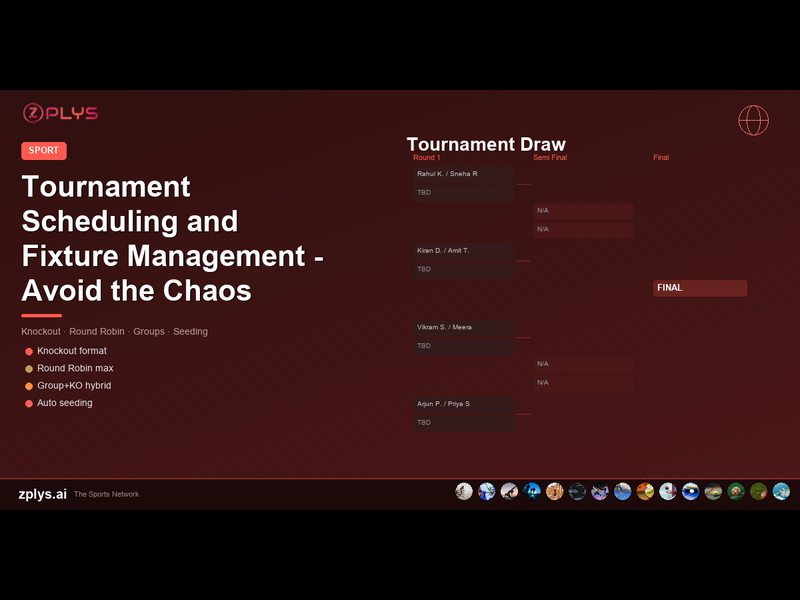
A well-drawn bracket is only half the job. The other half - the half that players actually experience - is scheduling. When is my match? On which court? How long until my next game? Can I leave for lunch and come back?
Bad scheduling turns a fun tournament into a frustrating day of waiting. Players arrive at 9 AM for a match that starts at noon because the previous round ran late. They play back-to-back matches without rest while others have 3-hour gaps. The organizer spends the day firefighting instead of hosting.
Good scheduling is invisible. Players show up, play, rest, play again, and go home feeling like the day flowed naturally. Here is how to make that happen.
The Scheduling Math
Start with the fundamentals:
- ●Average match duration: badminton 25-35 min, tennis 45-70 min, pickleball 15-25 min, cricket (T10) 90 min, table tennis 20-30 min
- ●Add 5-10 minutes between matches for changeover (players leaving, new players setting up, umpire reset)
- ●So effective slot duration: match time + 10 min buffer
- ●Matches per court per hour: 1.5-2 for racket sports, ~0.6 for cricket
- ●Matches per court per day (8-hour event): 10-14 for racket sports, 4-5 for cricket
If you have 48 matches to play across 4 courts: 48 ÷ 4 = 12 matches per court. At 12 matches per court in an 8-hour day, that is tight but doable. If you have 60 matches and 3 courts, you are looking at 20 per court - either a 12-hour day or you need more courts.
Scheduling Rules That Prevent Chaos
Rule 1: No Player Plays Back-to-Back
If a player is in singles and doubles, schedule at least 30-45 minutes between their matches. This sounds obvious but is violated constantly in manually scheduled tournaments. The player who just played an exhausting singles semifinal should not walk onto court for a doubles quarterfinal 5 minutes later.
Rule 2: Group Stage Finishes Before Knockout Starts
In group + knockout formats, all group matches must complete before the knockout draw is populated. Schedule a 30-minute buffer between the last group match and the first knockout match. This gives you time to calculate standings, handle tiebreakers, and communicate the bracket.
Rule 3: Publish the Schedule in Advance
Players should know their approximate match time at least 2 hours before they play. For the first round, publish the full schedule when the draw is announced. For subsequent rounds, update the schedule as soon as the previous round finishes.
Rule 4: Build in Buffer Time
Things run late. Deuce games extend. Players arrive late. Equipment breaks. Build 30-60 minutes of buffer into your day. If you think you will finish at 5 PM, schedule as if you will finish at 6 PM. If everything runs smoothly, you finish early - and no one complains about finishing early.
The Technology Solution
Manual scheduling on paper or Excel takes 2-3 hours for a 48-match tournament and inevitably has conflicts (a player scheduled on two courts simultaneously, a court left empty while matches queue up).
Scheduling software does three things you cannot do manually:
- Conflict detection: it checks every player's schedule across all categories and flags overlaps.
- Court optimization: it allocates matches to courts to minimize idle time. If Court 1's match finishes early, the next match is automatically assigned there.
- Real-time updates: when a match runs long, the schedule shifts automatically for all subsequent matches, and players get notified of their updated time.
Zplys includes fixture scheduling with conflict detection and court allocation. The schedule is visible to all players in the app - no whiteboard needed, no missed announcements.
Communicating the Schedule
The best schedule in the world is useless if players do not know about it. Communication hierarchy:
- Tournament app/website: the primary source of truth. Players check their phone for their next match.
- Venue display: a screen or printed schedule at the registration desk, updated every round.
- PA announcements: for the next 2-3 matches on each court. "Court 2, next match: Arjun vs Rahul. Players please report."
- WhatsApp: individual messages 30 minutes before each match (automated through the platform).
Use all four channels. Different players prefer different communication methods, and redundancy prevents missed matches.
When Things Go Wrong
Despite your best planning, delays happen. Here is how to manage them:
- ●If one match runs long: absorb the delay into your buffer time. Do not compress subsequent matches.
- ●If multiple matches are delayed: announce a revised schedule. Be transparent: "We are running approximately 30 minutes behind schedule. Updated times are on the app and display board."
- ●If a player does not show up: wait 10 minutes past the scheduled time. If they do not respond to a phone call, award a walkover and move on. Do not hold up the entire tournament for one no-show.
- ●If it rains (outdoor events): have a clear rain policy communicated in advance. Options: wait 30 minutes for the rain to pass, switch to an indoor backup venue, or postpone affected matches to the buffer day.
Scheduling is the backbone of tournament operations. Get it right, and everything else falls into place.