
Tournament Draw Formats Explained - Knockout, Round Robin, and Group+KO

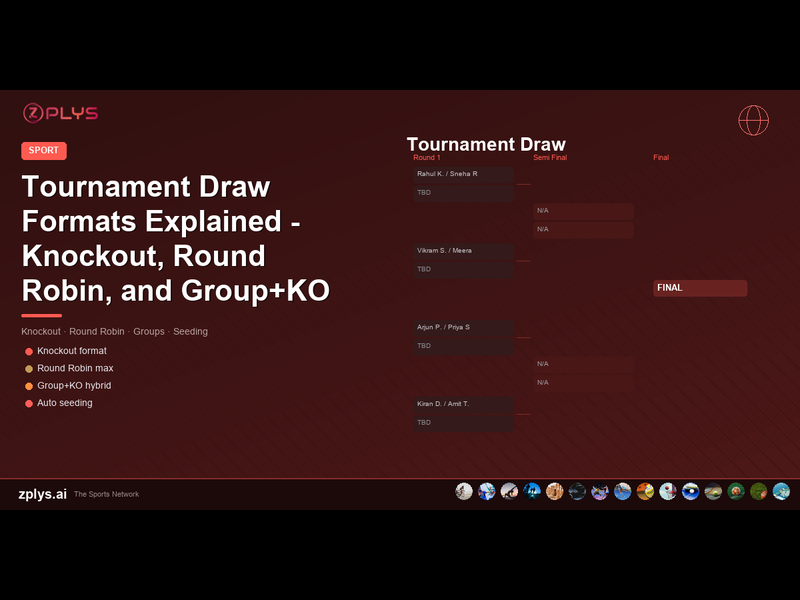
The draw format you choose defines the entire tournament experience. Pick the wrong one and you get either a three-hour event where half the players went home after one match, or a marathon that drags past midnight with exhausted players sleepwalking through their sixth group match.
There are three main formats used in Indian sports tournaments, and each has its place.
Knockout (Single Elimination)
How it works: lose one match, you are out. The bracket halves with each round - 32 becomes 16, then 8, 4, 2, and the final.
Pros: fast, dramatic, and easy to understand. A 32-player knockout needs only 31 matches. With 4 courts, you can finish in 5-6 hours. The bracket creates natural storylines - underdogs, upsets, rivalries.
Cons: a player who paid Rs 400 and travelled an hour might play one match, lose in 15 minutes, and go home. That is a poor experience, and they will think twice before registering for your next tournament. There is also the luck factor - a strong player drawn against the top seed in round 1 is eliminated without getting a fair chance.
When to use it: large player counts (64+) where time is limited, events with a strong competitive focus, and later stages of a group + knockout format.
Seeding is critical in knockouts. Without seeding, the two best players could meet in round 1. Standard seeding protocol: the top seed is placed at the top of the draw, the second seed at the bottom. Seeds 3 and 4 go in opposite halves. This ensures the best players meet only in the later rounds.
Byes: when your player count is not a power of 2 (8, 16, 32, 64), you need byes. If you have 20 players in a 32-draw, there are 12 byes. Seeded players should receive byes first. Byes are placed in round 1 only - never in later rounds.
Round Robin (Everyone Plays Everyone)
How it works: every player plays every other player in their group or the entire field. The player with the most wins (or best point difference) finishes first.
Pros: every player gets multiple matches. A round robin with 8 players means 7 matches each. No one goes home after one loss. This format rewards consistency over single-match form.
Cons: time-intensive. A round robin with 8 players needs 28 matches. With 16 players, that is 120 matches - practically impossible in a single day. It also lacks the knockout drama. The winner might be decided before the final match is even played.
When to use it: small groups (4-6 players), league-style competitions that run over multiple weeks, and situations where maximum playing time is the priority.
Points systems for round robin: Win = 2 points, Loss = 1 point, No show = 0 points (giving 1 point for a loss prevents players from dropping out after a couple of losses). Tiebreakers: head-to-head result first, then point difference (points scored minus points conceded), then points scored.
Group + Knockout (The Best of Both)
How it works: players are divided into groups of 3-4. Each group plays a round robin. The top 1 or 2 from each group advance to a knockout bracket.
This is the format used in most professional tournaments - the FIFA World Cup, BWF World Championships, and IPL (groups → playoffs). There is a reason: it gives every player at least 2-3 matches (group stage), then ramps up the intensity with do-or-die knockouts.
Pros: guaranteed minimum matches for every player. The strongest players usually advance (multiple chances to prove themselves). Creates two distinct phases of excitement - the "will they qualify?" of groups and the "one mistake and you're out" of knockouts.
Cons: takes longer than pure knockout. Requires careful group composition to avoid unbalanced groups (one group of death, one group of walkovers). Scheduling is more complex because group matches may need to finish before knockouts can begin.
Best configuration for common player counts:
- ●16 players: 4 groups of 4, top 2 advance → 8-player knockout (QF, SF, Final). Total: 24 group matches + 7 knockout = 31 matches.
- ●24 players: 8 groups of 3, top 1 advances → 8-player knockout. Total: 24 group matches + 7 knockout = 31 matches.
- ●32 players: 8 groups of 4, top 2 advance → 16-player knockout. Total: 48 group matches + 15 knockout = 63 matches.
Choosing the Right Format
Ask yourself three questions:
- How many players do you have? Under 12: round robin. 12-32: group + knockout. Over 32: knockout or group + knockout with many groups.
- How much time do you have? One day (8 hours) with 4 courts: maximum 80 matches, so up to 32 players in group + KO format. Half a day: pure knockout only.
- What is the priority - competition or participation? If players are paying to play and you want repeat registrations, group + knockout ensures everyone gets their money's worth. If it is a ranking tournament with serious competitive players, pure knockout is accepted.
The Technology Difference
Creating draws by hand is possible but painful. Group + knockout formats require calculating group standings, applying tiebreakers, and feeding group winners into a knockout bracket - all while 60 players are asking "when is my next match?"
Tournament management platforms like Zplys generate draws automatically. You select the format, add players, set seeds, and the system creates groups, schedules matches, and builds the knockout bracket. As match scores come in, standings update in real time and the bracket populates itself.
The time savings compound. A 32-player group + knockout draw that takes 2 hours to create manually takes 2 minutes in software. Updating standings after each match takes 30 seconds instead of 5 minutes of manual calculation. By the end of a 60-match tournament, you have saved 3-4 hours of admin - time better spent ensuring the event runs smoothly.
The Format Nobody Talks About: Consolation Draws
Here is an idea for your next knockout tournament: run a consolation draw alongside the main bracket. Every player who loses in round 1 enters a separate knockout among the first-round losers. The winner gets a consolation prize.
Cost: zero (same venue, same time - consolation matches use courts freed up as the main draw progresses). Benefit: every player gets at least two matches, and the consolation final can be as exciting as the main final. Several club tournaments in India have adopted this, and first-round losers who used to go home now stay for the entire event.