
Tennis Coaching Centre Management - Batches, Courts, and Scheduling

Why Tennis Academy Management Is Uniquely Complex
Tennis is different from team sports like football or cricket in one critical way: court capacity is hard-capped. A football ground can absorb 20 kids with creative drills. A tennis court maxes out at 6 students per coach for group lessons, and even that is stretching it for anything beyond beginner level.
This means your entire business model revolves around court utilization. Every empty court hour is lost revenue. Every overcrowded court is a quality compromise that leads to dropouts. Getting the batch structure and scheduling right is not just an operational task - it is the core strategic challenge of running a tennis centre.
Court Economics
Court Costs Across India
- ●**Municipal courts**: Rs 200-500 per hour. Available in most cities but often in poor condition (cracked surfaces, no lights). Booking is competitive.
- ●**Club courts**: Rs 500-1,500 per hour. Better maintained, often hard or synthetic surface. Reliable booking but limited hours.
- ●**Private tennis facilities**: Rs 15,000-40,000 per court per month for dedicated access. This is the model for serious academies.
- ●**Building your own**: Rs 12-25 lakh for a synthetic hard court (excluding land). Ongoing maintenance: Rs 3,000-6,000 per month per court.
A tennis coaching centre in Jubilee Hills, Hyderabad operates on 3 private courts at Rs 25,000 per court per month. Total facility cost: Rs 75,000. With 14 usable hours per day (6 AM-8 PM, minus 2 PM-4 PM heat break), that is 42 court-hours daily. At an average of Rs 400 revenue per court-hour (accounting for batch sizes and pricing), their daily revenue potential is Rs 16,800 - or roughly Rs 5 lakh per month. After facility costs, coaching salaries, and overheads, they clear Rs 2-2.5 lakh in profit with 90 students.
Batch Structure: The Court-Hour Framework
Think in court-hours, not batches. Every court-hour should have a defined purpose and price point.
Beginners (0-6 months experience)
- ●**Group size**: 4-6 students per court per coach
- ●**Session length**: 60 minutes
- ●**Frequency**: 3 sessions per week
- ●**Pricing**: Rs 3,000-5,000/month
- ●**Revenue per court-hour**: Rs 750-1,250 (assuming 5 students average)
Intermediate (6 months-2 years)
- ●**Group size**: 3-4 students per court per coach
- ●**Session length**: 75-90 minutes
- ●**Frequency**: 3-4 sessions per week
- ●**Pricing**: Rs 4,000-7,000/month
- ●**Revenue per court-hour**: Rs 800-1,400
Advanced/Competitive
- ●**Group size**: 2-3 students per court per coach
- ●**Session length**: 90-120 minutes
- ●**Frequency**: 5-6 sessions per week
- ●**Pricing**: Rs 6,000-12,000/month
- ●**Revenue per court-hour**: Rs 600-1,200
Private Coaching
- ●**Group size**: 1 student per court per coach
- ●**Session length**: 60 minutes
- ●**Pricing**: Rs 800-2,000 per session
- ●**Revenue per court-hour**: Rs 800-2,000
Notice that beginners actually generate the highest revenue per court-hour. This is why smart tennis centres never neglect their beginner pipeline - it is the most profitable segment.
The Scheduling Puzzle
Tennis scheduling in India has three immovable constraints: heat, light, and school timings.
The Typical Day (October-February)
- ●**6:00-8:00 AM**: Premium adult and advanced junior slots (coolest hours, highest demand)
- ●**8:00-10:00 AM**: Junior beginner and intermediate batches (school kids before school or on holidays)
- ●**10:00 AM-2:00 PM**: Private coaching, adult recreational. Lower demand.
- ●**2:00-4:00 PM**: Dead zone in most Indian cities. Too hot. Use for court maintenance.
- ●**4:00-6:30 PM**: Peak junior hours (after school). Your most valuable court-hours.
- ●**6:30-8:00 PM**: Adult batches, advanced junior overflow (requires lights).
Summer Adjustment (March-June)
- ●Morning sessions start at 5:30 AM
- ●Afternoon dead zone extends from 11:00 AM to 4:30 PM
- ●Evening sessions extend to 8:30 PM with floodlights
- ●Add extra morning batches during school holidays - demand spikes here
A coaching centre in Baner, Pune shared that they generate 60% of their monthly revenue from the 4:00-7:00 PM window. Those 3 hours across their 2 courts are worth more than the remaining 11 hours combined. This is why floodlights are not optional - they are a revenue multiplier.
Equipment and Ball Management
Tennis balls are a surprisingly significant expense. A pressurized ball lasts 2-3 sessions of group coaching before it goes dead. At Rs 150-250 per can of 3 balls, you are spending Rs 5,000-10,000 per month on balls alone for a 3-court operation.
Tips from experienced coaches:
- ●Use pressureless balls for beginners - they last 10x longer and cost Rs 50-80 each
- ●Rotate pressurized balls: new balls for advanced/competitive, once-used balls for intermediate, dead balls for basket feeding drills
- ●Invest in a ball hopper (Rs 2,000-4,000) - it saves 10-15 minutes per session in ball collection
- ●Buy rackets for beginners to use during trial classes. 4-5 junior rackets at Rs 1,500-2,500 each is a Rs 10,000 investment that pays for itself in trial conversions
Technology for Court Management
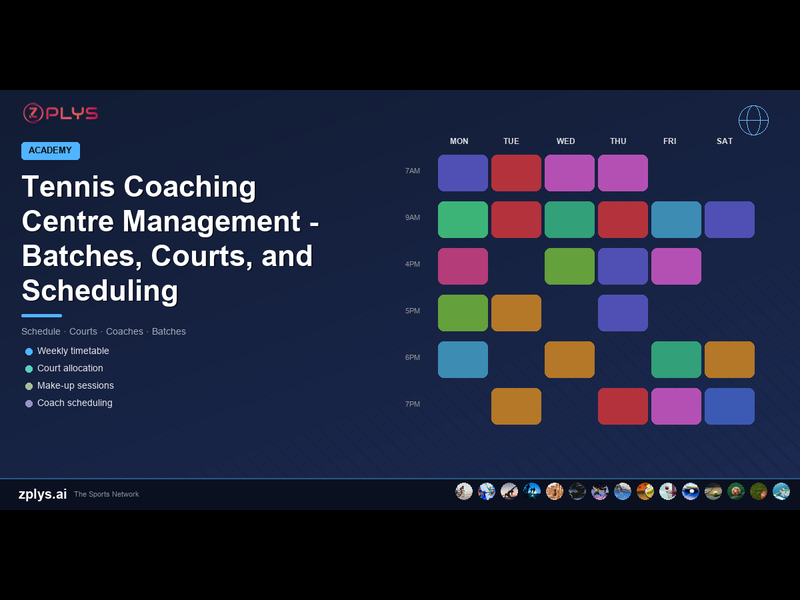
As your centre grows beyond 2 courts and 60 students, manual scheduling breaks. You need a system that handles:
- ●Court allocation per time slot
- ●Student-to-batch assignment with waitlist management
- ●Coach scheduling across courts and time slots
- ●Makeup session tracking (when students miss a class)
- ●Automated fee reminders linked to active enrollment
Spreadsheets work until they do not. Most tennis centres hit the breaking point around 80 students and 3 coaches. At that point, moving to a platform like Zplys - which handles student management, batch scheduling, and payments together - saves the owner 6-8 hours per week of administrative work.
Retention Through Competition
Tennis has an excellent competitive ecosystem in India through AITA and state associations. Start with intra-academy ladder matches (monthly, ranked by level), then progress to district-level AITA tournaments. A coaching centre in Ahmedabad manages tournament entries for all their competitive students and charges a Rs 500 coordination fee per event. Parents happily pay for the convenience.
The centres that thrive treat every court-hour as a revenue opportunity, every beginner as a future competitive player, and every parent as a long-term relationship worth investing in.