
Player Performance Tracking - Why Parents Are Demanding Data

A parent walks into your office after three months of enrollment. "My son has been training five days a week for twelve weeks. Is he actually getting better?" You say yes, of course. You describe the improvement you have seen - his footwork is cleaner, his shot selection is better, he is more consistent. The parent nods but does not look fully convinced.
Because your evidence is your opinion. And parents - especially those paying Rs 5,000 to Rs 10,000 per month - want something more concrete than a coach's subjective assessment.
This is not unreasonable. When parents send kids to academic tuition, they get test scores. When they go to a doctor, they get lab reports. Sports coaching is one of the few services where the provider says "trust me, it's working" and the customer is expected to accept it.
What Performance Tracking Actually Looks Like
You do not need motion sensors, video analysis AI, or a sports science lab. You need a simple, consistent system for measuring and recording improvement over time.
For Racket Sports (Badminton, Tennis, Squash, Pickleball)
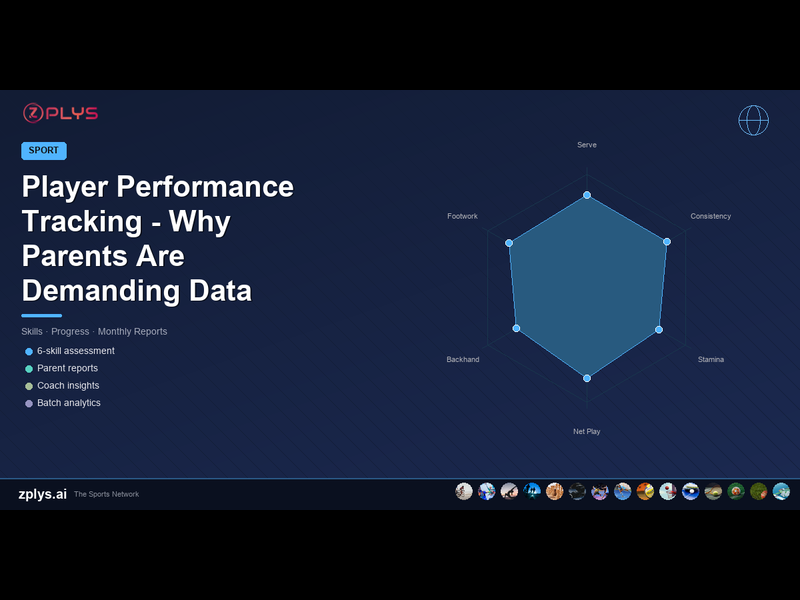
Assess these 6 skills on a 1-5 scale every month:
- ●Serve accuracy (can they place the serve where they want?)
- ●Footwork and court coverage
- ●Forehand consistency (out of 20 shots, how many land in?)
- ●Backhand consistency
- ●Net play and reactions
- ●Match temperament (handling pressure points)
A 30-point scale across 6 skills. Assessed during the last session of each month. Takes 10 minutes per student. After three months, you have a clear trend line.
For Cricket
Track differently for batters and bowlers:
Batting: strike rotation, shot selection against pace/spin, footwork, power hitting, mental composure. Bowling: accuracy (hitting target zones), variations, pace consistency, economy in match simulations, field setting awareness.
For Swimming
Time trials once a month for each stroke. 50m and 100m. The numbers speak for themselves - a 50m freestyle dropping from 42 seconds to 38 seconds over four months is undeniable progress.
Making It Practical for Coaches
The reason most academies do not track performance is not that coaches are lazy. It is that the systems are either too complex (fill out this 20-field form for each student every week) or too informal (keep mental notes).
The right system has three properties:
- It takes less than 15 minutes per batch per month
- It fits into the last session of the month naturally (make assessment day a regular part of the schedule)
- It produces output that parents can see without coach interpretation (a chart that shows improvement is worth more than a paragraph of feedback)
Management platforms like Zplys include player performance modules where coaches can tap ratings on their phone during or after a session. The platform generates progress charts that are shared with parents automatically.
What to Share With Parents
A monthly progress report should include:
- ●Skill ratings compared to previous month (visual: green arrows for improvement, yellow for steady, red for decline)
- ●Attendance for the month (parents correlate attendance with improvement - which is accurate)
- ●One or two sentences of coach commentary ("Arjun's backhand has improved significantly. Next month we'll focus on his net play.")
- ●Session highlights if available (photos or short video clips from training)
Keep it simple and visual. A bar chart showing improvement across six skills over four months tells the story better than a 500-word written report.
The Retention Impact
Academies that share monthly progress reports have measurably better retention. Here is why: the decision to renew happens in the parent's mind, not the student's. If the parent can see tangible improvement, renewal is a non-decision. If they cannot see improvement - even if the student is objectively getting better - doubt creeps in.
A badminton academy in Bangalore introduced monthly skill assessments and shared results via WhatsApp. Their quarterly churn rate dropped from 18% to 9%. When asked why they stayed, parents consistently cited "I can see the improvement" as their top reason.
Beyond Individual Tracking - Batch and Academy Analytics
Once you have individual performance data, aggregate it. Which batch has the fastest improvement curve? Which skills are your coaches strongest at teaching? Are students who attend 4+ sessions per week improving faster than those attending 3? (Spoiler: yes, significantly.)
This data helps you make coaching decisions. If footwork scores are consistently low across all batches, maybe your footwork drills need updating. If one coach's students improve 20% faster, understand what that coach is doing differently and replicate it.
Getting Started This Week
Week 1: Define 5-6 skills relevant to your sport. Create a 1-5 rating scale for each. Week 2: Assess your current batch during the last session. Record scores on your phone (even a notes app works to start). Week 3: Share a simple summary with parents ("Here is where [Student] stands today. We'll reassess next month to track progress."). Week 4: Set up a management platform with built-in performance tracking so assessments auto-generate parent reports.
The first assessment takes effort. By the third month, it is routine. And the first time a parent says "I can actually see how much my daughter has improved" - that is when you realise tracking is not extra work. It is the proof that your coaching is worth every rupee.