
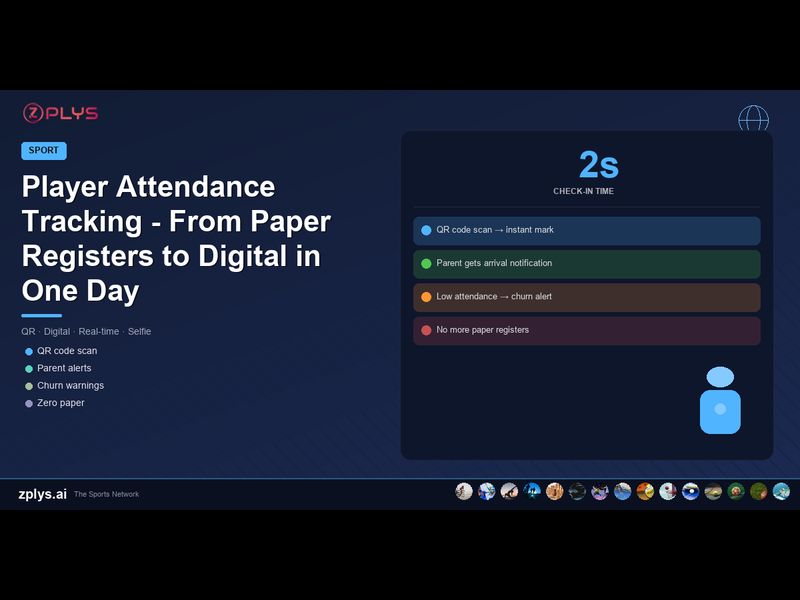
Player Attendance Tracking - From Paper Registers to Digital in One Day

Every coaching session in India starts the same way. The coach pulls out a register, flips to today's date, and starts calling names. Twenty students, twenty responses, five minutes gone. Some students mumble. Some are in the washroom. The coach marks them present anyway because re-checking later is too much hassle.
By the end of the month, the register tells a story that is about 70% accurate. Good enough? Not when parents are paying Rs 4,000 a month and asking, "How many sessions did my child actually attend?"
The Real Cost of Paper Attendance
Five minutes per batch, four batches per day, six days a week. That is two hours per week - over 100 hours per year - spent on a task that a phone can do in seconds. But the time cost is not even the biggest problem.
The bigger issue is data reliability. Paper registers get wet, torn, or lost. Coaches mark attendance retroactively ("I think Rahul was here on Tuesday"). There is no way for parents to verify independently. And when a parent disputes - "My son attended 22 sessions, not 18" - you have no objective record to settle it.
A karate academy in Hyderabad had a parent threaten to leave after a billing dispute that came down to attendance records. The coach said 16 sessions, the parent counted 20. Neither could prove their number. They settled by waiving a month's fee - Rs 6,000 lost because of a Rs 50 register.
How Digital Attendance Works
There are three common approaches, and they all beat paper:
QR Code Check-In
A QR code is displayed at the academy (printed poster or a screen). Students or parents scan it with their phone when they arrive. The scan records the student, the time, and the batch. Takes 3 seconds. No names to call, no register to carry.
Best for: academies with older students (12+) who have phones, or where parents drop off and scan at the entrance.
App-Based Check-In
The coach opens the attendance screen on their phone, sees the batch list, and taps to mark present or absent. The whole batch of 20 students takes under a minute. The record syncs to the cloud instantly.
Best for: academies where students are young (under 12) and do not carry phones.
Selfie Attendance
The student or parent takes a selfie at the academy, which is geotagged and timestamped. This is the most tamper-proof method - there is visual proof of presence at the location at the recorded time.
Best for: academies that need strict verification (competitive programs, attendance-linked fee structures).
Setting It Up - A One-Day Migration
You do not need a week to switch. Here is a realistic same-day plan:
Morning: Sign up for a platform that supports digital attendance (Zplys offers all three methods above). Import your student list - name, phone, batch. A CSV upload takes 10 minutes for 200 students.
Afternoon: Brief your coaches. Show them the app, let them tap through one attendance session on a test batch. The interface is designed for coaches standing on a court - large buttons, minimal typing, works on any Android phone.
Evening batch: Go live. Use digital attendance for one batch while keeping your paper register as a backup. Compare at the end of the session. They will match. Drop the paper register tomorrow.
What Parents See
This is the part that sells itself. Parents receive a notification when their child checks in. They can open the app and see: total sessions this month, sessions attended, attendance percentage, and a calendar view showing which days their child trained.
No more "did my child go to practice today?" calls. No more disputes about session counts. One academy owner in Pune told us that parent satisfaction scores (measured through Google reviews) jumped from 3.8 to 4.6 stars within two months of introducing attendance notifications. Parents felt informed and in control.
Linking Attendance to Fees
Some academies charge per session rather than per month. Digital attendance makes this model viable at scale. The system counts sessions automatically and generates the invoice at month-end. No manual counting, no disputes.
Even for monthly billing, attendance data is valuable. If a student attends fewer than 50% of sessions for two consecutive months, it is an early warning sign of churn. You can reach out proactively - "We noticed Arjun has missed several sessions. Is everything okay? Would a batch time change help?" - before the parent quietly stops showing up.
Privacy and Data
A reasonable concern: is this tracking too invasive? The short answer is no, because you are only recording what you already record on paper - who showed up and when. The digital version is more accurate and more transparent (parents can see it, unlike your paper register that sits in a drawer).
That said, be transparent about it. Tell parents during enrollment: "We use digital attendance so you can track your child's sessions in real time." Frame it as a benefit, because it is one.
The Numbers After 30 Days
Academies that switch to digital attendance consistently report: 90%+ attendance accuracy (vs 70% with paper), 5-10 hours per month saved on admin, 15-20% reduction in parent complaints about session counts, and earlier detection of student disengagement.
The register served its purpose for decades. But when a free app on your phone does the same job in a fraction of the time with perfect accuracy, it is time to let the paper go.