
Pickleball Tournaments in India — A Complete Organizer's Handbook

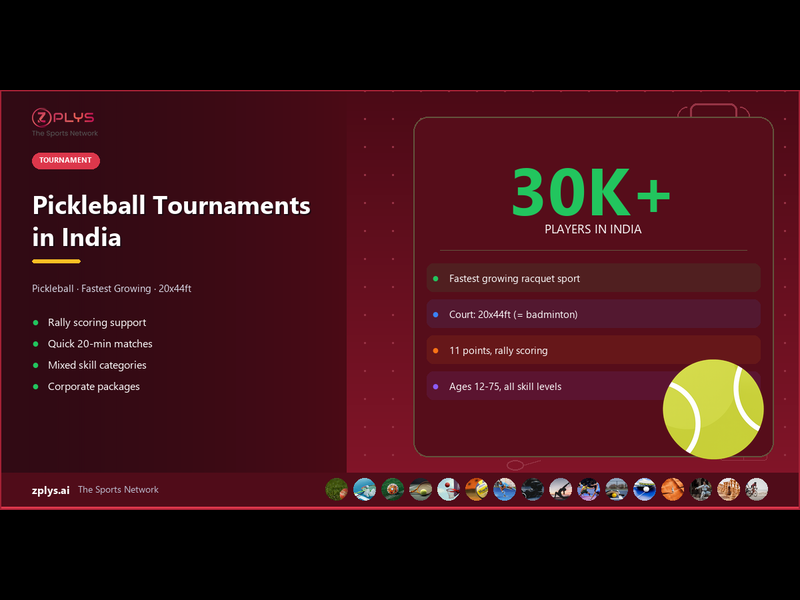
Pickleball went from "what is that?" to India's fastest-growing racquet sport in about three years. The Pickleball Federation of India reports over 30,000 active players across 200+ cities. Tournaments are popping up every weekend — in metro cities, tier-2 towns, retirement communities, and corporate campuses.
If you are thinking about organizing one, the timing could not be better. Here is the practical guide.
Why Pickleball Tournaments Work So Well
Pickleball has three properties that make it ideal for tournaments:
Short match duration: a singles match takes 15–20 minutes, doubles about 20–25. You can run 15–20 matches per court per day. Compare that to tennis (60–90 minutes per match) or badminton (30–45 minutes). More matches means more players, more action, and a faster event.
Mixed skill levels play together: the sport is accessible enough that beginners and intermediate players can compete in the same tournament without it being embarrassing. Separate categories by skill level, and everyone has a competitive experience.
Social nature: pickleball attracts a community-oriented crowd. Players stay to watch other matches, cheer for friends, and socialize. Your tournament becomes a social event, not just a competition.
Court Setup and Venue
A standard pickleball court is 20 feet × 44 feet (6.1m × 13.4m) — roughly a quarter of a tennis court. This means you can fit 4 pickleball courts in one tennis court. A venue with 2 tennis courts gives you 8 pickleball courts — enough for a 64-player tournament.
If you are using badminton courts (20 feet × 44 feet), the dimensions are almost identical. Most indoor badminton halls can host pickleball with minimal modification — just tape the pickleball lines (the kitchen/non-volley zone, which is 7 feet from the net on each side).
Equipment per court: one portable pickleball net (regulation height: 34 inches at center, 36 inches at posts), court line tape if not permanently marked, and 2–3 outdoor or indoor balls (indoor balls have 26 holes, outdoor have 40 — use what matches your venue).
Categories for Indian Tournaments
The pickleball community in India spans ages 12 to 75, which is unusually wide. Categories should reflect this:
Open Singles (Men's and Women's)
Open Doubles (Men's, Women's, Mixed)
Age categories: Under-19, 35+, 50+, 60+
Skill categories: Beginners (playing < 6 months), Intermediate (6–18 months), Advanced (18+ months or rated players)
For a first tournament, keep it to 4–6 categories. You can always add more as your event grows.
Scoring Rules Reminder
Pickleball scoring confuses newcomers because only the serving team can score (in traditional scoring). Here is the quick version:
Games to 11 points, win by 2 (cap at 15 in some formats)
Only the serving team scores
In doubles: both players on a team serve before a side-out (except at the start of the game, where only one player from the starting team serves)
The score is called as three numbers: server's score, receiver's score, server number (1 or 2). "4-2-1" means the serving team has 4 points, the receiving team has 2, and it is the first server.
For tournaments, rally scoring (both sides can score on any rally, games to 15 or 21) is becoming more popular because it creates predictable match durations. This is important for scheduling.
Registration and Draw
Online registration is especially important for pickleball because many players are new to competitive play and may not know the tournament protocol. Your registration page should clearly explain: the format, the scoring system, skill level definitions (so players self-select the right category), what to bring (paddle, water, indoor shoes if required), and the schedule structure.
Platforms like Zplys support pickleball-specific scoring and draw formats. The draw creation handles group + knockout, which works particularly well for pickleball — short group matches ensure everyone plays at least 3 games.
Day-of-Tournament Tips Specific to Pickleball
Warm-up courts: designate one court for warm-ups. Players arriving early need a place to hit, and you do not want them disrupting scheduled matches on competition courts.
Noise levels: pickleball is loud (the paddle-ball impact carries). If you are in an indoor venue, warn neighbours. If outdoor, check local noise ordinances for weekend mornings.
Ball management: outdoor balls crack frequently in Indian heat. Stock 3–4 balls per court for the day. Replace cracked balls immediately — they change trajectory unpredictably.
Kitchen violations: the most common dispute in pickleball is whether a player stepped into the non-volley zone (kitchen) during a volley. Assign line judges for semifinal and final matches, or use umpires who understand pickleball rules.
Growing the Event
Pickleball tournaments build community fast. After your first event, create a WhatsApp group for participants. Share results, photos, and the date of the next tournament. Many organizers run monthly or bi-monthly events that grow from 32 players to 100+ within a year.
Partner with local pickleball clubs, RWAs (Resident Welfare Associations), and sports facilities. The sport's growth trajectory in India means your event will naturally attract more players with each edition.
Corporate pickleball tournaments are an emerging segment. Companies are looking for team-building activities that are inclusive (pickleball's low barrier to entry is perfect) and fun. A corporate tournament package — venue, equipment, scoring, prizes — can command Rs 50,000–1,50,000 per event.