
Online Sports Registration in India - The Complete Guide

The Rs 500 Problem
A table tennis organizer in Nagpur charges Rs 500 per player for a weekend tournament. With 80 expected participants, that is Rs 40,000 in entry fees. In the old model - cash at the venue or UPI transfers to a personal account - here is what actually happens: 60 players pay in advance, 15 say they will pay at the venue and 5 of those never show up, 3 payments are disputed because the organizer cannot match a UPI transaction to a name, and 2 players demand refunds because they registered but did not read the format details.
The organizer spends 6-8 hours across two weeks just managing payments. That is unpaid labour that directly reduces the quality of the event itself, because those hours should have gone into scheduling, court setup, and volunteer coordination.
Online registration solves this entire category of problems. Not partially. Completely.
What Online Registration Actually Involves
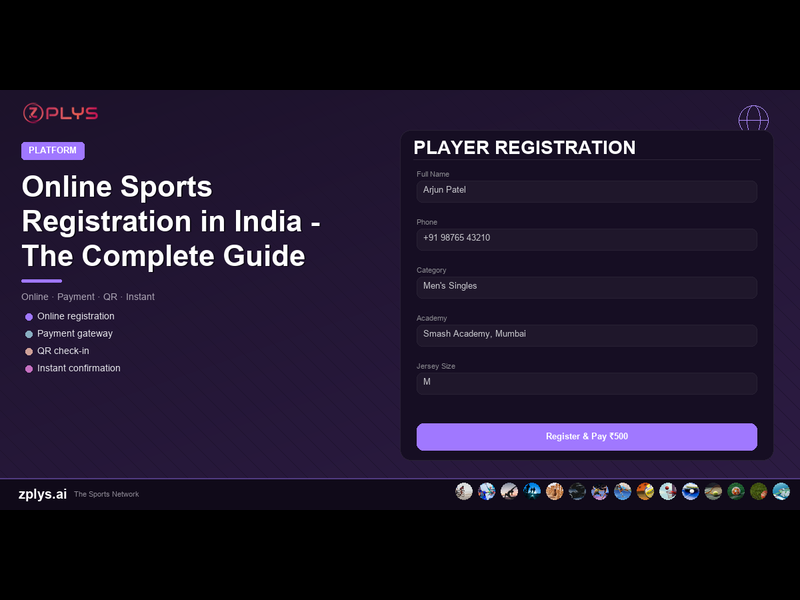
Registration is more than a Google Form with a QR code. A proper online registration system handles five things simultaneously:
- **Information collection** - Player name, age, contact details, and sport-specific data (singles/doubles, category, skill level, team name). Custom fields for whatever the organizer needs: T-shirt size, dietary preferences for catered events, medical declarations, ID proof uploads.
- **Category and eligibility management** - Automatically filtering players into correct age groups, gender categories, or skill divisions based on their profile data. A 16-year-old should not be able to register for an over-35 veterans category.
- **Payment processing** - Collecting entry fees through UPI, cards, or net banking with automatic reconciliation. Every payment is linked to a specific registration. No ambiguity.
- **Confirmation and communication** - Instant confirmation via WhatsApp or SMS with registration details, payment receipt, and event information.
- **Organizer dashboard** - Real-time view of registrations, payment status, category fill rates, and waitlist management.
Setting Up Online Registration - Step by Step
Choose Your Platform
For small events (under 30 participants), a Google Form plus manual payment tracking can work. But the moment you cross 50 participants or charge entry fees, you need a dedicated platform. Options like Zplys handle the heavy lifting - registration, payment, communication - in one flow.
Define Your Categories and Pricing
Be specific. A badminton tournament should list every category with its entry fee:
- ●Men's Singles (Open) - Rs 600
- ●Women's Singles (Open) - Rs 500
- ●Men's Doubles (Open) - Rs 800 per pair
- ●Mixed Doubles - Rs 800 per pair
- ●Under-15 Boys Singles - Rs 400
- ●Under-15 Girls Singles - Rs 400
Early bird discounts work well for driving early registrations. A 20% discount for registrations in the first week is common and effective - a Pune badminton organizer who introduced early bird pricing saw 65% of registrations come in during the first 3 days, compared to a last-minute rush previously.
Configure Custom Fields
Think about what you actually need from participants. Common custom fields for Indian sports events:
- ●State sports association registration number (for sanctioned events)
- ●School or college name and ID (for inter-institutional events)
- ●Blood group and emergency contact (increasingly required by venues)
- ●Accommodation requirements (for outstation participants)
- ●Previous tournament results (for seeding purposes)
- ●T-shirt size (if merchandise is included in the entry fee)
Do not over-collect. Every additional required field reduces your completion rate by 5-10%. Ask only what you genuinely need.
Set Up Payment
Indian payment processing for sports events typically works in one of three ways:
- ●**Platform-integrated payments:** The registration platform handles payment collection and settles with you. Simplest option. Transaction fees typically range from 2-3% including GST.
- ●**Direct UPI with verification:** You provide a UPI ID, players pay and upload a screenshot during registration. Better than nothing, but still requires manual verification.
- ●**Payment links:** Generate individual payment links per registration. Middle ground between manual and fully integrated.
For any tournament with more than 50 participants, platform-integrated payment is worth the 2-3% transaction fee. The time you save on reconciliation alone justifies the cost.
Configure Registration Rules
Important settings that organizers often forget:
- ●**Registration deadline** - When does registration close? Allow at least 48 hours before the event for draw creation and scheduling.
- ●**Maximum participants per category** - If you have 4 courts and 8 hours, you can realistically handle about 32 players in a singles knockout. Set the cap accordingly.
- ●**Refund policy** - State it clearly upfront. Common approaches: full refund if cancelled 7+ days before, 50% refund 3-7 days before, no refund within 3 days. This prevents disputes.
- ●**Partner registration** - For doubles events, decide whether both partners must register individually or one player can register the pair.
The Communication Layer - WhatsApp Is Non-Negotiable
In India, email open rates for sports events hover around 15-20%. WhatsApp message read rates are above 90%. If your registration system does not send WhatsApp confirmations, you will spend your evenings answering did-my-registration-go-through messages.
Automated WhatsApp messages should cover:
- ●Registration confirmation with payment receipt
- ●Draw publication and match schedule
- ●Day-before reminders with venue details and reporting time
- ●Any changes or updates (venue change, schedule modification, weather delay)
Handling Common Registration Issues
The Partner Problem
Doubles registration is the most common source of confusion. Two approaches work:
- ●**One registers, one confirms:** Player A registers for doubles and names Player B. Player B receives a notification and confirms their participation and pays their share if applicable.
- ●**Both register independently, then link:** Both players register separately and indicate their preferred partner. The system matches them.
The first approach is simpler for players but requires the system to handle split payments. The second is cleaner from a payment perspective but requires coordination between partners.
The Refund Request
Clear refund policies stated at registration time prevent 90% of refund disputes. For the remaining 10% - genuine emergencies, injuries, family situations - having a simple process matters. A dashboard where organizers can initiate refunds with one click, rather than manually processing UPI returns, saves significant hassle.
The Last-Minute Registration
Every organizer gets the 11 PM phone call the night before asking to still register. Having a clear online cutoff where registration closes automatically at a set time removes the organizer from this decision. The system says no. It is not personal.
Measuring Registration Success
After your event, look at these metrics to improve next time:
- ●**Conversion rate:** How many people started registration versus completed it? If you are losing 40%+ at the payment step, your pricing might be too high or your payment options too limited.
- ●**Time to fill:** How quickly did categories fill up? If a category fills in 2 hours, you might have room to expand it or raise the price next time.
- ●**Refund rate:** Above 10% suggests unclear communication about format, venue, or dates.
- ●**Channel attribution:** Where did registrations come from? WhatsApp shares, Instagram posts, direct links? This tells you where to focus your promotion next time.
The shift from manual to online registration is not just about convenience - it is about professionalism. When a participant in Chennai receives an instant WhatsApp confirmation with a clean registration receipt, they trust the event more. That trust translates to more registrations, fewer no-shows, and a willingness to pay higher entry fees for a well-run event.