
Live Scoring in Sports Tournaments - Why Paper Scorecards Are Killing Your Event

It is 3 PM at a badminton tournament in Hyderabad. Court 3 just finished a semifinal - a nail-biter that went to the third game. The scorer walks to the tournament desk, hands over a paper score sheet. The desk volunteer squints at the handwriting, asks "Is this a 7 or a 1?", gets it wrong, updates the whiteboard bracket, and moves on.
Meanwhile, 40 players are crowded around the whiteboard trying to find their next match. A parent calls the organizer asking who won. A player from Court 1 says his score was entered wrong. The desk is now dealing with three things at once.
This is the reality of paper scoring at most Indian tournaments. It works - barely - but it creates friction at every step.
The Paper Scoring Problem
Paper score sheets have been the standard for decades. They are cheap, they do not need batteries, and everyone knows how to use them. But they have four fundamental problems:
- Delay: the score exists only on paper until someone physically carries it to the desk and the desk manually updates the bracket. There is a 5-15 minute delay between a match ending and the results being available.
- Errors: handwriting misread, scores transposed, wrong player names. In a 60-match tournament, expect 3-5 scoring errors. Each one takes 10-15 minutes to investigate and correct.
- No live visibility: players waiting for their next match cannot see ongoing scores. They rely on announcements, which are inconsistent. Spectators following from outside the venue have no information at all.
- No permanent record: paper sheets get lost, damaged, or thrown away. After the tournament, there is no reliable record of individual match scores, only the final bracket.
What Digital Scoring Changes
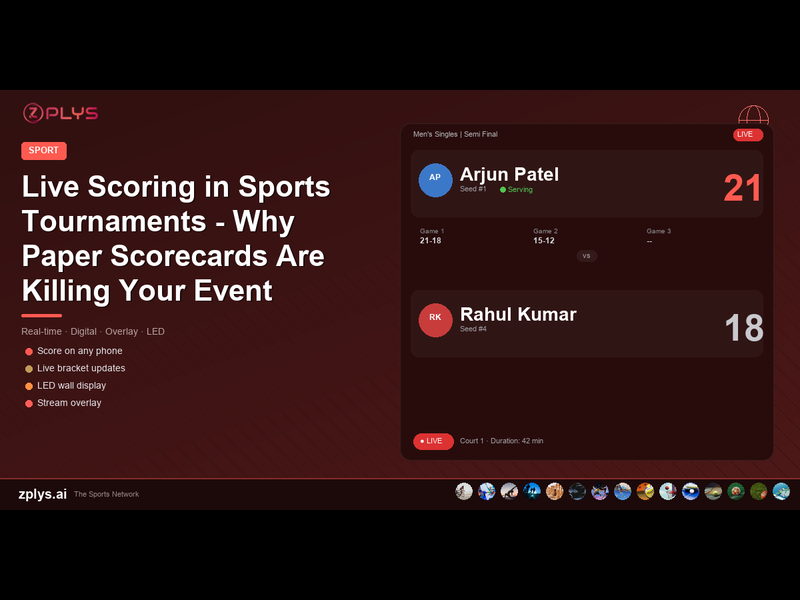
Digital scoring means an umpire or scorer enters points on a phone or tablet as the match progresses. The score appears in real time on:
- ●The tournament app for all players and spectators
- ●A display board at the venue (connected to a screen or projector)
- ●The tournament bracket, which updates automatically when the match ends
- ●A live stream overlay, if you are broadcasting
The moment a point is scored, everyone everywhere knows. No paper, no walking to the desk, no squinting at handwriting.
The Player Experience Transformation
Before digital scoring, the player experience between matches is: sit around, walk to the whiteboard every 10 minutes, ask other players if they know the scores on other courts, worry about missing their call.
After digital scoring: open the app, see all live matches, check when your next match is likely (based on current match progress), get a notification when you are called. The anxiety disappears.
One tournament organizer in Mumbai told us that the most common feedback after they switched to digital scoring was not about the scoring itself - it was "I actually enjoyed the tournament because I could relax between matches instead of constantly checking the board."
Setting Up Live Scoring
You do not need expensive hardware. Here is the minimum setup:
- ●A tournament management app with live scoring (Zplys supports scoring for badminton, tennis, cricket, pickleball, squash, and more)
- ●A smartphone per court (can be the umpire's personal phone)
- ●The match list pre-loaded on each phone
- ●Internet connection (4G is sufficient - the data transmitted per point is tiny)
Optional but impressive: a TV or monitor at the venue showing the live bracket, connected to the tournament platform's display mode. A projector works too. Players and spectators gather around the screen instead of the whiteboard.
The LED Wall and Overlay
For larger tournaments or events with live streaming, a digital scoring system enables features that are simply impossible with paper:
- ●LED wall display: a stadium-ready screen showing the current match score, upcoming matches, and bracket progress. Used in college and corporate tournaments where a professional look matters.
- ●Live stream overlay: the score appears as an overlay on your YouTube or Facebook live stream, just like you see in professional broadcasts. Players watching from home see scores update in real time.
These features used to require expensive broadcast equipment and a dedicated production team. Today, a tournament app generates the overlay as a browser page that you add to OBS (free streaming software) as a source. Total cost for a professional-looking broadcast: Rs 0 beyond the equipment you already have.
Handling Objections
"Our umpires are not tech-savvy." The scoring interface on a phone is literally a + button. Tap when a point is scored. If the umpire can operate WhatsApp, they can operate live scoring. A 5-minute tutorial before the tournament is sufficient.
"What if the phone dies or internet drops?" Phones last 6+ hours on a full charge during scoring (low screen brightness, minimal processing). Carry a power bank as backup. For internet, 4G works fine - the data per match is under 1 MB. If internet drops momentarily, the app queues the update and syncs when connection returns.
"Paper is simpler." Paper is simpler for the scorer. It is worse for everyone else - players, spectators, organizers, and the tournament desk. Digital scoring shifts 2 minutes of extra effort to the scorer and saves hours of collective frustration for everyone else.
The Organizer Benefit
Beyond the player experience, digital scoring gives you something paper never can: data. After the tournament, you have complete match-by-match scores, game durations, player statistics, and bracket progression - all exportable.
This data is useful for: identifying strong players for seeding in future events, understanding match duration for better scheduling, providing players with a stats summary ("You scored 187 points across 5 matches, won 73% of rally points in game 3"), and creating highlight reels with accurate score overlays.
Paper gives you a winner. Digital scoring gives you the story of how they won.