
IPL-Style Auction for Local Tournaments - Yes, You Can Do It

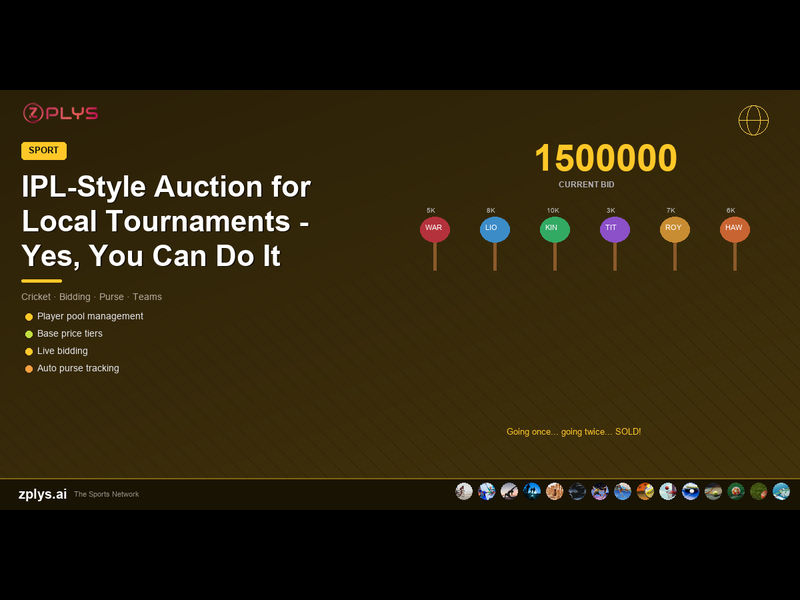
Every cricket fan in India has watched an IPL auction and thought, "What if we did this for our Sunday league?" The answer is: you can, and it is easier than you think. You do not need a five-star hotel ballroom, celebrity anchors, or Rs 100 crore budgets. What you need is a room, a screen, 8 enthusiastic team owners, and about two hours of setup.
Local player auctions have exploded across India in the last two years. Colony tournaments, corporate leagues, college fests, and city-level competitions are all adopting the auction format - because nothing else generates the same pre-tournament buzz.
Why Auctions Beat Traditional Team Selection
The old way: captains take turns picking players. It is fair, it is simple, and it is mind-numbingly boring. The captain picks their friends first, the best players go in round one, and by round four everyone is going through the motions.
The auction way: every player is contested. The fast bowler who everyone wants goes for Rs 15,000. The unknown kid from the neighbouring colony gets picked up for base price - and then scores a century in the tournament and becomes the story of the event. The team owner who spent their entire purse on two marquee players and got stuck with base-price fillers learns a lesson about balance.
Auctions create stories that players talk about for months. "Remember when Ravi went for Rs 12,000 and Sharma ji's team had only Rs 3,000 left for five slots?" These stories are the marketing for your next tournament.
What You Need
The Non-Negotiables
- ●6-10 team owners who are invested in the process (they will build the drama)
- ●60-120 players in the pool (7-12 per team minimum)
- ●A projector or TV screen showing the current player, bid amount, and team purse
- ●An auctioneer with energy and crowd management skills
- ●A scoring system that tracks purse, bids, and squad composition in real time
The Nice-to-Haves
- ●Background music (the IPL auction theme song is on YouTube - play it during big bids)
- ●Team bidding paddles with team logos (print on cardboard - Rs 50 each)
- ●A backdrop with the tournament name and sponsor logos
- ●Live streaming on YouTube/Instagram for players who cannot attend
- ●WhatsApp notifications to players when they are sold ("Congratulations! You've been picked by Team Warriors for Rs 5,000")
Setting the Right Budget
The purse amount does not need to represent real money (though some tournaments tie it to actual entry fees). What matters is that the numbers create meaningful choices.
A common setup for local tournaments: Rs 1,00,000 purse per team (in auction currency), base prices of Rs 1,000 (Category C), Rs 3,000 (Category B), and Rs 5,000 (Category A). With 11 players to buy, teams cannot afford to go all-in on two expensive players without struggling to fill the rest of the squad.
This tension is what makes auctions exciting. If the purse is too large relative to player prices, there is no competition - every team can afford everyone. If it is too small, only a few players get contested and the rest go at base price. The sweet spot: total purse should be about 1.5-2x the sum of all minimum squad costs.
The IPL-Style Overlay - Making It Look Professional
This is the detail that elevates a room-and-projector auction into an IPL-like experience. An overlay is a graphical display showing:
- ●The current player: photo, name, role, stats, base price
- ●Current highest bid and which team placed it
- ●A countdown timer (15-30 seconds per bid round)
- ●Team purse balances and squad fill status
Platforms like Zplys provide a live auction overlay that you project on screen or add to your live stream. The overlay updates in real time as bids are placed - the auctioneer or a designated operator clicks a button, and the screen changes. No PowerPoint slides, no manual updates.
The overlay comes in multiple themes and layouts. Pick one that matches your tournament branding - maroon and gold for a premium feel, blue and white for a clean corporate look, or neon for a college fest vibe.
The Live Streaming Angle
Streaming your auction on YouTube or Instagram Live adds a layer of reach and credibility. Players who cannot attend the venue follow along on their phones. Family members tune in to see when their son gets picked. The archived video becomes promotion for the tournament.
Technical setup is simple: a phone or webcam pointed at the venue, OBS (free software) on a laptop for adding the auction overlay, and a stable internet connection (4G hotspot works if venue WiFi is unreliable). The overlay from Zplys is designed to work as a browser source in OBS - add it once and it updates automatically.
Managing the Energy
The auction's success depends on energy management. Here is the typical energy curve:
- ●First 15 minutes: high energy. The first set of marquee players triggers competitive bidding. Owners are aggressive, the crowd is excited.
- ●Middle 60 minutes: energy dips. Mid-tier players are being picked. Bids are smaller. The audience checks their phones.
- ●Last 30 minutes: energy spikes again. Teams are running low on budget. Every bid is calculated. Unsold players are re-presented at reduced prices. Surprise picks happen.
The auctioneer's job is to maintain energy through the middle section. Quick commentary, player anecdotes ("This guy hit four sixes in last year's final"), and occasional humour keep the room alive.
Other energy boosters: play music between sets. Have a snack break after Set 3. Announce running totals ("Team Warriors has the most expensive squad so far at Rs 78,000"). Create friendly rivalry between team owners - the crowd feeds on it.
What Makes Players Love It
We talked to players who have been through local auction experiences. The feedback was overwhelmingly positive:
"Knowing my base price was Rs 3,000 and being sold for Rs 8,000 was the biggest confidence boost I've had in cricket." "When the two strongest teams were fighting over me, everyone in the room was looking at me. Best feeling ever." "Even going unsold was fine - I got picked in the recovery round and scored 45 in the first match. Proved them wrong."
The auction gives every player a moment. Unlike a quiet captain's pick where nobody knows what happened, the auction is public, dramatic, and personal. Players remember their auction price for years.
Starting Small
If this is your first auction, keep it manageable: 8 teams, 80 players, 3 sets, 2 hours. Run it in a living room or community hall. Use a TV instead of a projector. Have one person managing the software while the auctioneer handles the room.
By the second edition, you will have sponsors lining up, players asking to be in the pool, and team owners strategising weeks in advance. The auction sells the tournament before a single ball is bowled.