
How to Start a Sports Academy in India — A Practical Guide

Starting a sports academy sounds straightforward until you actually sit down to do it. You know your sport, you can coach, and there are kids in your area who need proper training. But between that first idea and your first batch of students, there are about forty decisions that nobody warns you about.
This guide is built from conversations with academy owners across India — people running badminton centres in Pune, cricket academies in Hyderabad, and swimming programs in Bangalore. Their mistakes and wins are baked into every section.
Pick Your Sport and Niche Before Anything Else
The temptation is to offer everything. Badminton, cricket, football, tennis — the more sports, the more students, right? Not quite. Multi-sport academies work, but only after you have established credibility in one discipline first. Coaches who try to launch with four sports simultaneously end up spreading themselves thin on equipment, coaching staff, and marketing.
Start with the sport you coach best. If you are a national-level badminton player, lead with badminton. You can add swimming or fitness training six months later once your first sport has a waitlist.
Your niche matters too. Are you targeting competitive players who want to enter state and national tournaments? Or recreational players — working professionals, weekend warriors, kids whose parents want them off screens? The answer changes everything: your pricing, your facility needs, your coaching approach, and your marketing.
Location and Facility — The Biggest Cost Decision
Rent will be your largest expense for the first two years. Here is a rough breakdown of what academy owners report across tier-1 and tier-2 Indian cities:
Badminton court rental (shared, per hour): Rs 800–2,000 in metros, Rs 400–800 in tier-2 cities
Own facility lease (2–4 courts): Rs 80,000–3,00,000/month depending on city and area
Cricket ground with nets: Rs 50,000–1,50,000/month
Swimming pool partnership: Rs 30,000–80,000/month for reserved lanes
Many successful academies start by renting court time at existing facilities rather than leasing their own space. A badminton academy in Chennai started with two hours of rented court time at a local club, five days a week. Within eight months, they had enough students to justify their own four-court facility.
Look for locations near schools and residential areas. Parents drive the decision for kids under 14, and they will not travel more than 15–20 minutes. For adult programs, proximity to IT parks or business districts works well.
Legal Setup and Registration
You have three options for legal structure in India:
Sole Proprietorship — simplest to set up, but you are personally liable for everything. Fine for a small academy with under 50 students.
LLP (Limited Liability Partnership) — better protection, moderate compliance. Good for two or more co-founders.
Private Limited Company — most compliance overhead, but best if you plan to raise investment or scale to multiple locations.
Regardless of structure, you will need: GST registration (mandatory if revenue exceeds Rs 20 lakh), a current account in your business name, professional liability insurance (often overlooked — covers you if a student gets injured during training), and any sport-specific certifications your state requires.
Building Your Coaching Team
Your first hire matters more than your facility. A great coach in a basic facility will build a reputation. A mediocre coach in a world-class facility will not.
Where to find coaches: state-level players transitioning out of competitive careers, physical education graduates from universities like LNIPE Gwalior or Chennai's YMCA College, and retired armed forces sports personnel (the military produces excellent coaches who understand discipline and structured training).
Pay structures vary widely. Full-time coaches in metros earn Rs 25,000–60,000/month. Per-session coaches charge Rs 500–2,000 per hour depending on their credentials and the sport. A common model for new academies: one full-time head coach (you, probably) plus two part-time assistants for peak batches.
Pricing and Batch Structure
Pricing is where most new academy owners either leave money on the table or price themselves out of the market. Research what other academies in your area charge, then position yourself based on your coaching credentials and facility quality.
Typical monthly fee ranges across Indian cities:
Recreational batches (3 sessions/week): Rs 2,000–5,000
Competitive training (5–6 sessions/week): Rs 5,000–15,000
Personal training (1-on-1): Rs 1,000–3,000 per session
Summer camps (2–4 weeks): Rs 5,000–15,000
Batch sizes matter for quality and revenue. Badminton and tennis work best with 6–8 students per court per batch. Cricket nets can handle 8–12. Swimming lanes typically support 4–6 per lane. Overfilling batches saves money in the short term but kills your reputation.
Operations and Management From Day One
This is where most academies struggle after the first three months. The coaching is going well, students are joining, but the admin piles up: tracking who paid, marking attendance, communicating with parents, scheduling make-up sessions.
Paper registers and WhatsApp groups work until you hit about 40 students. Beyond that, you start losing track. A coaching centre in Jaipur discovered they had Rs 1.2 lakh in unpaid fees they had not followed up on — simply because they were tracking payments in a notebook that nobody updated consistently.
Invest in a management platform early. Tools like Zplys handle fee collection with automated reminders, attendance tracking, batch scheduling, and parent communication in one place. The cost is typically Rs 999–2,000/month — less than one student's monthly fee — and it saves 10–15 hours of admin work per week.
Marketing Your Academy
Forget expensive newspaper ads and hoardings. The three channels that consistently work for sports academies in India:
Google My Business listing — free, and it is how parents search. "Badminton academy near me" gets thousands of searches monthly in any Indian metro. Add photos, respond to reviews, post updates weekly.
WhatsApp and word of mouth — your existing students are your best marketers. Run a referral program: one month free for every new student referred. Parent networks in schools and apartment complexes spread the word faster than any paid campaign.
Local school partnerships — offer a free demo session at schools. If even 5% of students from a school of 1,000 join, that is 50 new enrollments. Many academy owners report that school demonstrations are their single most effective acquisition channel.
Your First 90 Days — A Realistic Timeline
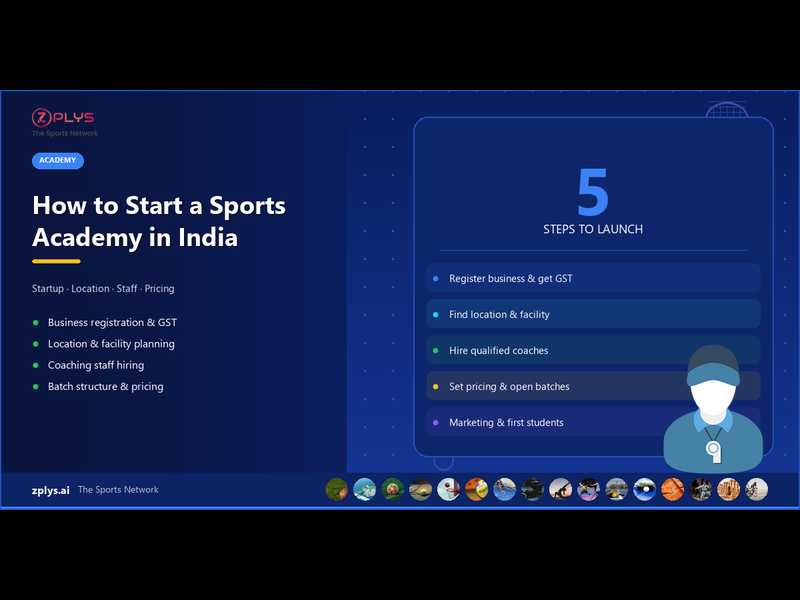
Weeks 1–2: Legal setup, location scouting, equipment procurement. Weeks 3–4: Coaching staff hiring, batch schedule creation, pricing finalization. Month 2: Soft launch with friends, family, and local school contacts. Run free trial sessions. Month 3: Full launch with Google My Business, local WhatsApp groups, and school demo sessions. Target: 30–50 students by end of month 3.
The academies that survive the first year share one trait: they treat it as a business from day one, not a hobby that happens to make money. Track your finances, invest in systems, hire good coaches, and the students will follow.