
How to Run a Cricket Tournament End-to-End

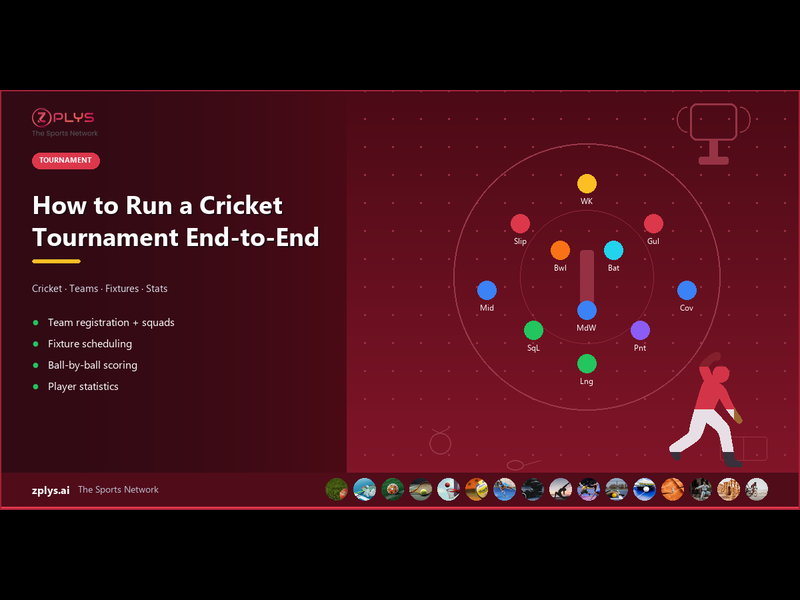
Cricket tournaments are different from individual-sport events in one fundamental way: you are managing teams, not players. This means more people, more logistics, more egos, and more things that can go sideways at 7 AM on match day when one team shows up with nine players instead of eleven.
But a well-organized cricket tournament is also one of the most rewarding events to run. The community engagement, the rivalries, the moments of brilliance on the field — nothing matches it. Here is how to make it work.
Format Decisions: Before Anything Else
Cricket tournament formats in India typically fall into three categories:
Box cricket (6-a-side, 6 overs): fast, fits on small grounds, usually 8–16 teams, finishes in one day. Popular for corporate events, colony tournaments, and indoor venues.
Tennis ball cricket (8–11-a-side, 10–15 overs): the backbone of local Indian cricket. Played on open grounds, 8–32 teams, runs 2–4 weekends.
Leather ball cricket (11-a-side, 20–50 overs): serious club and district-level cricket. 8–16 teams, runs over multiple weekends. Requires proper pitches, equipment, and umpires.
Your format dictates everything else: venue needs, number of days, umpire requirements, budget, and prize expectations. Decide this first.
Team Registration and Squad Management
For team tournaments, registration is per team — one captain registers the team, submits the squad list, and pays the entry fee for the entire team.
What you need from each team: team name and logo (optional), captain name and phone, full squad list (names and phone numbers — minimum 11, maximum 15–18), playing category (if applicable), and entry fee payment.
Entry fees for Indian cricket tournaments: box cricket: Rs 2,000–5,000 per team, tennis ball: Rs 3,000–10,000 per team, leather ball: Rs 5,000–25,000 per team.
Squad verification matters. Set a deadline for final squad submission (48 hours before the first match). After that, no additions. This prevents teams from adding ringers after seeing the opposition.
Creating the Fixture
Cricket fixtures need more care than individual-sport draws because:
Each match takes 2–4 hours (vs 30 minutes for badminton)
You are often limited to one or two grounds
Teams may have players who work weekdays, limiting weekday matches
Weather is a factor — rain can wipe out an entire match day
For an 8-team tournament: Two groups of 4, each group plays a round robin (6 matches per group = 12 group matches). Top 2 from each group play semifinals. Winners play the final. Total: 15 matches. At 2 matches per day on one ground (morning and afternoon): 8 match days, typically spread over 4 weekends.
For 16 teams: direct knockout is fastest (15 matches, 8 match days). Group + knockout is better for player experience but requires 4–6 weekends.
Schedule buffer matches: always have a backup date for rained-out matches. Communicate the buffer dates upfront so teams keep them free.
Match Day Operations
Pre-Match
Toss 15 minutes before scheduled start time. Both captains, the umpire, and the organizer present.
Squad sheet submission: each team submits a playing XI from their registered squad. The scorer records it.
Ground inspection: if conditions are questionable (wet outfield, poor light), make the call early. Nothing is worse than starting a match and abandoning it at the 8th over.
During the Match
Scoring: ideally two scorers — one per team or one official scorer with a digital tool. Apps like Zplys support ball-by-ball cricket scoring with automatic run rate, wagon wheel, and partnership tracking.
Umpiring: for local tournaments, one umpire at the bowler's end is the minimum. Two umpires (one at each end) is standard for anything above box cricket. Pay your umpires — Rs 500–1,500 per match is standard for local-level officials.
Water breaks: every 30–45 minutes in Indian heat. Non-negotiable. Have water available at the ground, not just in the pavilion.
Post-Match
Update scores and standings immediately. Communicate results to all teams via WhatsApp or the tournament app.
If there is a dispute (no-ball controversy, player eligibility challenge), resolve it the same day. Delaying creates resentment.
Collect man-of-the-match nomination if you are tracking individual awards.
Scoring and Statistics
Cricket fans are statistics nerds. Even at the local level, players want to know their batting average, highest score, and economy rate. A digital scoring platform captures all of this automatically — every ball bowled, every run scored, every wicket taken.
At the end of the tournament, you can publish: top run scorers, highest individual score, best bowling figures, most catches, best batting average, best economy rate, and man-of-the-tournament (based on an all-round points system).
This data also helps with seeding and selection for future tournaments. It builds a track record for players, which matters in a country where local cricket is the pipeline to district, state, and beyond.
Budget and Sponsorship
A typical 8-team tennis ball cricket tournament budget:
Ground rental (8 days): Rs 40,000–80,000
Umpires (2 per match, 15 matches): Rs 15,000–30,000
Cricket balls (20 balls): Rs 3,000–5,000
Trophies and medals: Rs 15,000–30,000
Tents/shamiana for players: Rs 10,000–20,000
Refreshments: Rs 10,000–20,000
Miscellaneous: Rs 5,000–10,000
Total: Rs 98,000–1,95,000
Revenue sources: entry fees (8 teams × Rs 5,000 = Rs 40,000), sponsors (local businesses, sports brands, academies), food/beverage stalls (charge stall owners Rs 2,000–5,000 for setup rights), and spectator entry (Rs 50–100, if the venue allows — works for finals day).
Cricket tournaments can be profitable. A well-organized event with good sponsorship can generate Rs 50,000–1,00,000 surplus, which funds the next edition.
Technology That Makes It Manageable
Running a cricket tournament without software is possible but exhausting. The combination of team management, fixture scheduling, ball-by-ball scoring, and result computation — across multiple weekends — creates a workload that overwhelms spreadsheets.
A tournament management platform handles: online team registration with squad management, automatic fixture generation, live scoring with full statistics, real-time points table and bracket updates, player statistics across the tournament, and result sharing via the tournament page.
The investment is minimal compared to the hours saved. And the professional look — players checking scores on their phones, statistics shared after each match, a properly maintained points table — elevates your tournament from a casual weekend game to an event people want to return to.