
How to Organize a Tennis Tournament - Singles, Doubles, and Mixed

Why Tennis Tournaments Need a Different Playbook
Tennis tournaments are unlike most team sports events. You are dealing with individual entries, doubles pairings that may or may not know each other, court availability that shifts by the hour, and matches that can run anywhere from 40 minutes to three hours. A cricket tournament organizer can schedule eight matches across a weekend and call it done. A tennis tournament with 32 singles entries, 16 doubles pairs, and 8 mixed doubles teams can easily generate 80+ matches - all competing for the same four or six courts.
Having organized events at clubs from Chandigarh to Chennai, the single biggest lesson is this: court scheduling is the tournament. Get it right, and everything else follows. Get it wrong, and you will spend your weekend apologizing to players sitting in the clubhouse for three hours waiting for their match.
Setting Up Categories the Right Way
Before you open registrations, decide your category structure. A typical club-level tournament in India runs these categories:
- ●Men's Singles (Open, 35+, 45+, 55+)
- ●Women's Singles (Open, 35+)
- ●Men's Doubles (Open, 45+)
- ●Women's Doubles
- ●Mixed Doubles
The temptation is to offer every possible age group. Resist it. If your club in Pune has 60 registrations, spreading them across 10 categories means 6 players per category - barely enough for a meaningful draw. A better approach is to start with 4-5 categories and add more only if registrations justify it. Platforms like Zplys let you add categories after the tournament is created, so you do not have to commit upfront.
For doubles and mixed doubles, decide early whether players register as pairs or individually. Individual registration with a partner nomination field works best - it captures both players' details and avoids the classic problem where one partner registers and the other never shows up.
Seeding and Draw Construction
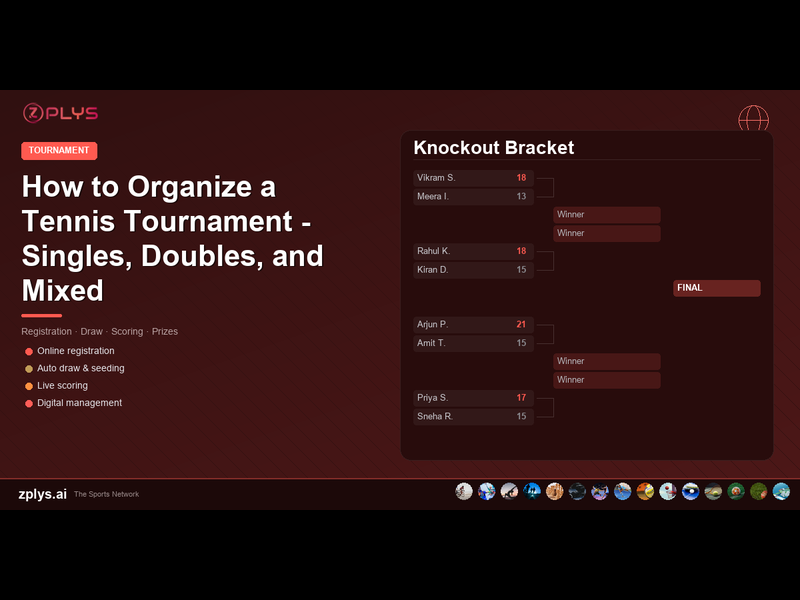
Seeding matters more in tennis than in most sports because a bad draw can ruin the tournament experience. The standard approach:
- Seed the top 4 players (or top 8 for draws of 32+) based on ranking, recent results, or club committee input
- Place seeds according to the standard separation formula - seeds 1 and 2 in opposite halves, seeds 3 and 4 in opposite quarters
- Randomize all unseeded players
- Apply byes to the first round if the draw is not a perfect power of 2, always giving byes to seeded players first
For a 24-player singles draw, you need 8 byes to reach a 32-bracket. The top 8 seeds get first-round byes and enter in the second round. This is not favoritism - it is standard tournament protocol used everywhere from local AITA events to Grand Slams.
Court Scheduling That Actually Works
Here is where most organizers struggle. If you have 4 courts and matches averaging 75 minutes, you can fit roughly 5-6 matches per court per day (accounting for changeover, warmup, and the inevitable match that goes to a third set). That gives you 20-24 matches per day.
A scheduling framework that works for a weekend tournament:
- ●**Saturday morning (7 AM - 12 PM):** First round singles across all courts
- ●**Saturday afternoon (2 PM - 7 PM):** Second round singles and first round doubles
- ●**Sunday morning (7 AM - 12 PM):** Quarterfinals and semifinals
- ●**Sunday afternoon (2 PM - 6 PM):** Finals across all categories
The critical rule: never schedule a player for back-to-back matches without at least a 90-minute gap. Players who registered for both singles and doubles will have overlapping schedules, and you need to build in recovery time.
Scoring and Match Management
Decide your scoring format before the draw is made and communicate it clearly:
- ●**Full sets (best of 3):** Standard for finals and semifinals, but makes scheduling unpredictable
- ●**Pro sets (first to 8 games):** Popular at club level in India, keeps matches under 60 minutes
- ●**Short sets (first to 4 games with tiebreak at 3-all):** Gaining popularity for round-robin stages
For round-robin groups in doubles, short sets work brilliantly. A group of 4 teams plays 6 matches, and with short sets, you can complete an entire group on one court in about 4 hours.
Live scoring is a game-changer for multi-court tournaments. When you have matches running simultaneously on 4-6 courts, players need to know when their next match is. A digital scoring system that updates brackets in real-time eliminates the constant "when is my next match?" questions that plague every tournament desk.
Registration and Communication
Set your entry fees based on local benchmarks. Club tournaments in metros like Bangalore or Mumbai typically charge Rs 500-800 per singles entry and Rs 800-1200 per doubles team. Tier-2 cities like Indore or Coimbatore usually run Rs 300-500 for singles.
Collect these details at registration:
- ●Full name and phone number
- ●Age (for age-group categories)
- ●AITA ranking or rating (if applicable)
- ●Doubles partner name and phone (for doubles categories)
- ●T-shirt size (if you are providing tournament merchandise)
WhatsApp groups work for small club events, but once you cross 40 players, a broadcast approach is better. Send schedule updates, court assignments, and result notifications through a platform that supports bulk messaging rather than relying on a group where important messages get buried under 200 "congratulations" replies.
Day-of-Tournament Operations
Station one volunteer at the tournament desk permanently. Their only job is tracking match completions and updating the draw. When a match finishes on Court 3, they should know within two minutes so the next match can be called.
Keep a buffer of 2-3 matches ready to go at all times. If Court 1 finishes early, you should be able to immediately call the next match rather than hunting for players in the parking lot.
Have extra cans of balls for every court, water stations accessible from all courts, and a basic first-aid kit. These are small details that separate a well-run tournament from a chaotic one. Players remember the experience long after they forget the scores.
Post-Tournament Wrap-Up
Within 24 hours of the tournament ending, publish complete results - not just the winners, but full draw sheets showing every match score. Players want to see their results, share them on social media, and compare with friends. This also builds credibility for your next edition. A tournament with publicly available, well-documented results attracts better players the following year.