
How to Organize a Badminton Tournament - The Definitive Guide

You have been playing badminton for years. Your club has 40 members. Someone suggests organizing a tournament. Everyone agrees. And then - silence. Because nobody actually knows how to pull it off.
Running a badminton tournament is not complicated, but it has about thirty moving parts that all need to work together. Miss one (say, you forgot to arrange shuttle cocks for the knockout rounds) and the event falls apart at 2 PM on a Saturday with 64 players staring at you.
This guide covers every step, from the moment you decide to host a tournament to the moment you hand out the last trophy.
Step 1: Define the Format and Categories
Before booking a venue or setting a date, decide exactly what you are organizing:
- ●Singles, doubles, or mixed doubles? Or all three?
- ●Age categories: Under-13, Under-17, Open, 35+, 45+?
- ●Skill categories: Beginners, Intermediate, Advanced?
- ●Format: Knockout (fastest), Round Robin (everyone plays more), or Group + Knockout (best of both)?
A common first-tournament mistake is offering too many categories. Eight categories with 16 players each means 128 registrations, 200+ matches, and two full days of non-stop court time. Start with 3-4 categories for your first event.
For a club-level tournament with 50-80 players, a good starting structure: Men's Singles (Open), Women's Singles, Men's Doubles, and Mixed Doubles. Each in Group + Knockout format - 4 groups of 4, top 2 from each group advance to a quarterfinal knockout.
Step 2: Venue and Date
Courts needed: minimum 4 for a tournament with 60+ players. Fewer courts means longer days - 4 courts can comfortably handle 80 matches in 10 hours (20 matches per court, averaging 30 minutes each). Two courts? You are looking at a two-day event or very long days.
Book the venue at least 4 weeks in advance. Weekend dates fill fast. Check for local and state-level tournaments on the same weekend - you do not want to compete with a district championship for players.
Venue checklist: adequate lighting for all courts, seating for players waiting between matches, drinking water and washroom access, parking for 40-60 vehicles, a desk area for the tournament operations team, and a PA system or loud speaker for announcements.
Step 3: Registration
Open registration 3-4 weeks before the event. You need: player name, phone number, email, category (which events they are entering), partner name for doubles, and payment for entry fee.
Entry fees in India range from Rs 200-500 per category for club-level tournaments. Keep it affordable - the goal is participation, not profit from entry fees.
Online registration saves enormous hassle. Platforms like Zplys let you create a tournament page, set up categories with entry fees, and accept online payments. Players register themselves, you get a clean participant list with zero data entry.
Manual registration via Google Forms works but creates downstream problems: you have to manually match doubles partners, chase payments separately, and cross-reference spreadsheets when you create the draw.
Step 4: Creating the Draw
This is where most organizers spend hours on paper and still get it wrong. The draw needs to:
- ●Seed top players so they do not meet in early rounds
- ●Place club mates in different groups (so friends do not play each other in the group stage)
- ●Handle byes correctly when player count is not a perfect power of 2
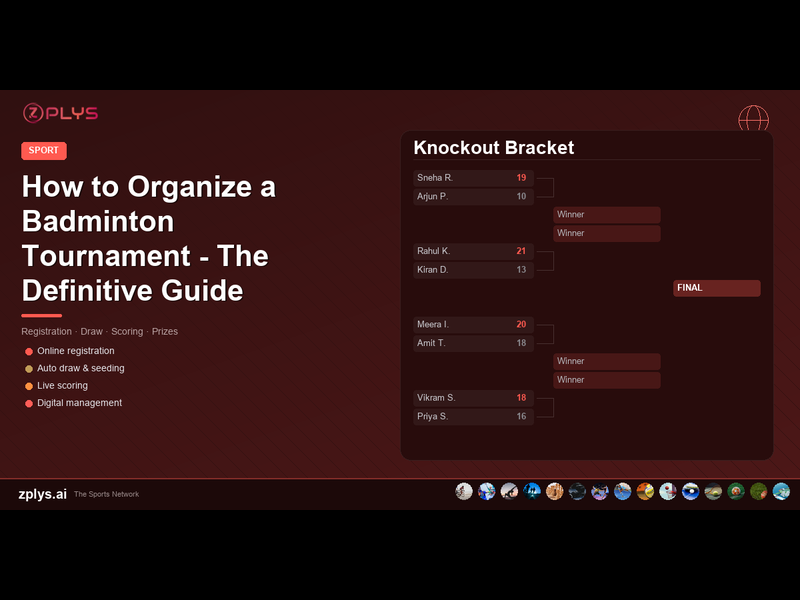
- ●Generate a bracket that is fair and visually clear
For knockout draws: you need 2, 4, 8, 16, 32, or 64 slots. If you have 20 players, you need a 32-draw with 12 byes. Seeded players get byes first.
For group + knockout: divide players into groups of 3-4. Each group plays a round robin. Top 1 or 2 from each group advance to the knockout stage.
Tournament management software generates draws automatically. You input the player list, set seeds, choose the format, and the system creates the draw with proper seeding and bye placement. What takes an organizer 2 hours on paper takes 30 seconds in software.
Step 5: Scheduling and Fixtures
Once the draw is created, schedule matches on courts and times. The schedule needs to account for:
- ●Players who are in multiple categories (cannot have two matches simultaneously)
- ●Rest time between matches (minimum 20 minutes, ideally 30-45)
- ●Court allocation to minimize downtime (no empty courts while players wait)
- ●A buffer for matches that run long (deuce games in badminton can extend 15-20 minutes beyond expected duration)
Print or display the schedule prominently. Use a large whiteboard at the venue showing: Court 1 - Match 1: Player A vs Player B (10:00 AM), Match 2: Player C vs Player D (10:30 AM), etc.
Digital scheduling through a tournament app lets players check their upcoming match time on their phone. No crowding around a whiteboard, no missed matches because a player did not hear the announcement.
Step 6: Match Day Operations
Day-of logistics that separate smooth tournaments from chaotic ones:
- ●Report time: players must check in 30 minutes before their first match. No-shows after 15 minutes get a walkover against them.
- ●Umpires: for club-level tournaments, losing-side umpiring (the loser of the previous match on that court umpires the next) is standard and accepted. For higher-level events, assign dedicated umpires.
- ●Scoring: paper score sheets are the traditional method but create problems - illegible writing, lost sheets, no live updates for waiting players. Digital scoring on a phone or tablet feeds directly into the bracket and updates results in real time.
- ●Shuttlecocks: provide tournament-grade feather shuttles for knockout rounds. Allow nylon for group stages if budget is tight. Keep a stock - a 64-player knockout tournament uses 30-50 shuttlecocks.
- ●Refreshments: water, energy drinks, and light snacks at minimum. For all-day tournaments, arrange lunch for players and volunteers.
Step 7: Scoring and Results
Standard badminton scoring: best of 3 games, each game to 21 points, with 2-point advantage required after 20-all (cap at 30). Make sure all umpires know the rules, especially the service rotation and the let rules.
Live scoring through a tournament app is a game-changer for player experience. Players in the waiting area can follow matches in progress, check when their match is likely to start, and see the bracket update in real time. Parents who could not attend can follow their child's matches remotely.
Results should update the bracket automatically. Manual bracket updates (erasing names and writing new ones on a whiteboard) are slow and error-prone. Software updates the bracket the moment a match score is entered.
Step 8: Prize Distribution
Keep the ceremony short and energetic. Winners, runners-up, and (optionally) semi-finalists for each category. Trophies or medals, certificates for all participants, and a group photo.
Budget for prizes: Rs 500-1,500 per trophy, Rs 50-100 per certificate, Rs 200-500 per medal. For a 4-category tournament: approximately Rs 8,000-15,000 for prizes.
Budget Overview
Here is a realistic budget for a 60-player, 4-category club tournament:
- ●Venue rental (1 day, 4 courts): Rs 15,000-40,000
- ●Shuttlecocks (40 tubes): Rs 8,000-15,000
- ●Prizes and certificates: Rs 10,000-20,000
- ●Refreshments: Rs 5,000-10,000
- ●Miscellaneous (printing, PA system, first aid): Rs 3,000-5,000
- ●Total: Rs 41,000-90,000
With entry fees of Rs 400 per category and an average of 1.5 categories per player: 60 × 1.5 × 400 = Rs 36,000 in entry fees. The gap is covered by sponsors - local businesses, sports shops, academy partnerships. One or two sponsors contributing Rs 15,000-25,000 each makes the event self-sustaining.
After the Tournament
Share results, photos, and highlights within 48 hours. Tag participants on social media. Send a thank-you message with a link to the results page. Ask for feedback - a 3-question Google Form is enough.
And start planning the next one. The second tournament is always easier because you have a participant database, sponsor relationships, and operational experience. Most successful recurring tournaments were shaky the first time and smooth by the third.