
How to Keep a Cricket Auction Fair and Transparent

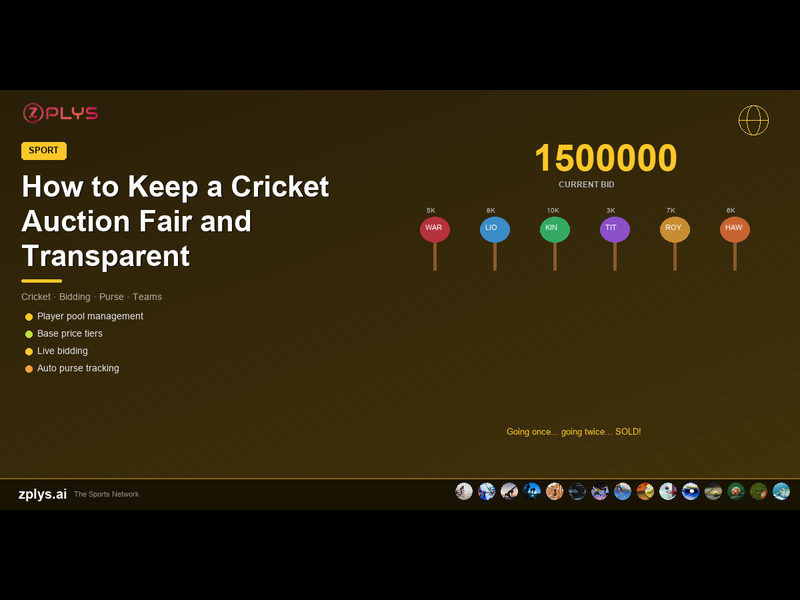
Nothing kills a tournament faster than a rigged auction. If players believe the fix was in - that certain players were steered to certain teams, that budget rules were bent, or that the auctioneer played favourites - the entire event loses credibility. Players drop out, sponsors distance themselves, and word spreads.
Keeping an auction fair is not just about good intentions. It requires specific rules, systems, and transparency mechanisms.
The Rules That Must Exist Before Day One
1. Player Pool Freeze
The player pool closes 48 hours before the auction. No additions, no removals after that deadline. This prevents last-minute manipulation - a team owner quietly adding their friend to the pool right before the auction.
2. Base Price Assignment
Base prices are assigned by a committee (not a single person), based on documented criteria: past tournament stats, playing level (club, district, state), and position scarcity. The criteria and the resulting price list are shared with all team owners 24 hours before the auction.
3. Purse and Squad Rules
Every team gets the same purse. No exceptions. Squad composition rules (minimum/maximum players, role quotas if applicable) are identical for all teams. These rules are documented and shared in writing.
4. Bidding Increment
Fixed increments - Rs 500 or Rs 1,000. Not variable, not at the auctioneer's discretion. The increment is announced at the start and does not change.
5. Conflict of Interest
If a team owner is also a player in the pool, they cannot bid on themselves. They are either a player or an owner, not both. If the auctioneer has a relationship with a team owner (family, business), disclose it beforehand.
Technology as the Fairness Enforcer
Rules are only as good as their enforcement. Technology removes human discretion from the process:
Real-Time Purse Tracking
The system calculates whether a team can legally place a bid. If Team A has Rs 8,000 left and needs to fill 3 more slots (minimum Rs 1,000 each), they cannot bid more than Rs 5,000 on the current player. The system prevents overbids automatically.
Bid History Log
Every bid is recorded with a timestamp: who bid, how much, for which player, at what time. This log is immutable and can be reviewed after the auction. If anyone claims the auctioneer missed their bid, the log shows exactly what happened.
Automated Squad Validation
If the rules say maximum 4 bowlers per team, the system blocks a 5th bowler purchase. No need for the auctioneer to remember every team's composition - the software enforces it.
Visible Team Status
Every team's purse balance, squad count, and remaining slots are displayed on the screen throughout the auction. Transparency is built into every frame. No one needs to ask "how much does Team B have left?" - it is right there.
Platforms like Zplys enforce all of these rules automatically. The auctioneer focuses on running the show; the software ensures the rules are followed.
The Auctioneer's Responsibilities
The auctioneer is the most powerful person in the room. They decide when bidding opens, when it closes, and the pace of the event. With that power comes responsibility:
- ●Call every bid clearly and loudly. If two teams bid simultaneously, acknowledge both and clarify who bid first.
- ●Give equal attention to all sides of the room. Do not consistently face one direction and miss bids from behind.
- ●Apply the countdown timer consistently. If Team A gets 15 seconds to bid, Team B gets 15 seconds. No extending the timer for friends.
- ●Do not editorialize during bidding. Saying "That seems like a lot for this player" or "Team C should bid here" influences outcomes. The auctioneer presents the player and manages bids - that is it.
Handling Disputes
Disputes will happen. Plan for them:
Disputed Bids
"I raised my paddle but the auctioneer didn't see it." Resolution: if the bid history shows no bid from that team, and the auctioneer confirms they did not see a paddle, the sale stands. Prevention: assign a spotter - a volunteer who watches for bids and signals the auctioneer.
Player Eligibility
"That player should not be Category A." Resolution: the category committee's decision is final. This is documented and shared in advance. Post-auction reclassification is not allowed.
Technical Errors
The system crashes, bids are lost, or a player is accidentally marked as sold to the wrong team. Resolution: pause the auction, review the bid log, correct the error, and resume. Transparency in the correction builds trust.
Post-Auction Audit
After the auction, publish the complete results:
- ●Every team's final squad with purchase prices
- ●The bid history log (which teams bid on which players)
- ●Final purse balances
- ●Unsold players list
Share this with all team owners and players within 24 hours. This level of transparency prevents post-auction gossip and builds trust for the next edition.
The Golden Rule
The fairest auction is the one where every team owner walks away saying, "I did not get everything I wanted, but the process was clean." They may not be happy with their squad, but they trust that the auction was legitimate. That trust is what makes them come back next year.
Build systems that enforce fairness, hire an auctioneer who embodies it, and publish results that prove it. The auction's reputation is the tournament's reputation.