
How to Generate Tournament Draws Automatically

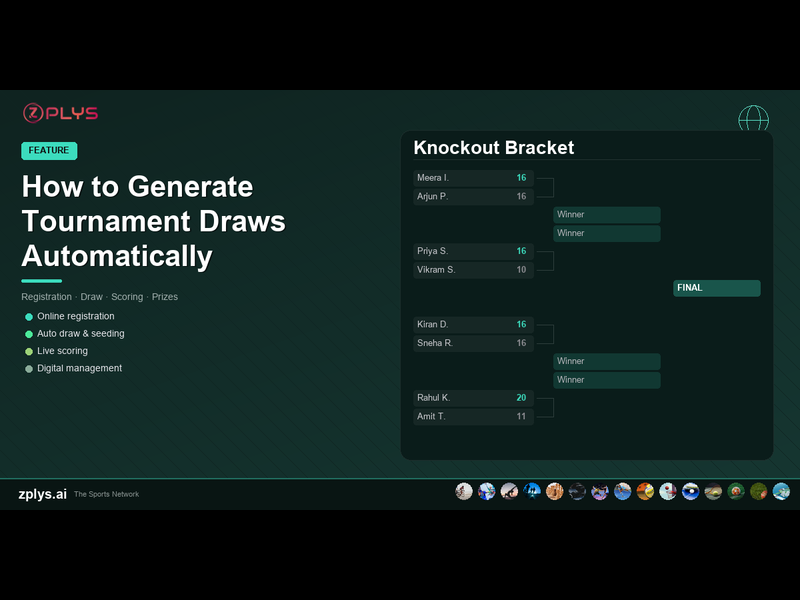
The Draw Day Nightmare
Picture this: 32 teams have registered for your badminton tournament in Lucknow. You need to create a knockout bracket with proper seeding, handle the 5 teams that got byes, and make sure no two teams from the same academy are in the same quarter. You open Excel. Three hours later, you've drawn, erased, and redrawn the bracket four times, and two academy coaches are calling you about unfair placement.
Automatic draw generation eliminates this entirely. What takes hours manually takes seconds with the right tool - and the output is consistent, fair, and auditable.
Understanding Draw Formats
Before generating anything, you need to pick the right format for your tournament.
Knockout (Single Elimination)
Every match eliminates the loser. 32 teams become 16, then 8, then 4, then 2, then a final. Best for:
- ●Large fields (32+ teams)
- ●Time-constrained tournaments (weekend events)
- ●Spectator-friendly drama (every match matters)
Group + Knockout
Teams play round-robin within groups, then top finishers advance to a knockout stage. Best for:
- ●Mid-size tournaments (12-24 teams)
- ●Ensuring every team plays multiple matches
- ●More accurate seeding for the knockout stage
Groups Only (Round Robin)
Every team plays every other team in their group (or in the tournament if small enough). Best for:
- ●Leagues that run over multiple weeks
- ●Small tournaments (4-8 teams)
- ●Formats where win/loss record matters more than single-elimination luck
How Automatic Draw Generation Works
Step 1: Input Your Parameters
The system needs to know:
- ●Total number of teams or players
- ●Desired format (knockout, group+KO, round robin)
- ●Number of groups (for group formats)
- ●Seeded players/teams (if any)
- ●Any placement constraints (no same-academy clashes in early rounds)
Step 2: Seeding Placement
Seeded players or teams are placed first. In a 32-team knockout:
- ●Seed 1 goes to the top of the upper half
- ●Seed 2 goes to the bottom of the lower half
- ●Seeds 3-4 are placed so they can only meet Seeds 1-2 in the semifinals
- ●Seeds 5-8 are placed in separate quarters
This ensures the best teams don't meet until the later rounds - which is the entire point of seeding.
Step 3: Bye Allocation
When your team count isn't a power of 2 (8, 16, 32, 64), some teams get byes in the first round. The system calculates how many byes are needed and assigns them to the highest seeds first.
For 24 teams in a knockout: 32 - 24 = 8 byes. The top 8 seeds skip round 1. The remaining 16 teams play round 1, producing 8 winners who face the 8 seeded teams in round 2.
Step 4: Random Placement
Unseeded teams are placed randomly into remaining slots. Good draw generators use proper randomization - not alphabetical order, not registration order, but genuinely random placement. This prevents any accusation of manipulation.
Step 5: Constraint Enforcement
Advanced draw systems let you set constraints:
- ●No two teams from the same club/academy in the same group
- ●Regional separation (teams from the same city in different halves)
- ●Previous-meeting avoidance (teams that played each other last tournament are separated)
Using Zplys for Draw Generation
The draw generation in Zplys follows a multi-step wizard:
- **Select categories** - if your tournament has multiple age groups or skill divisions, select which category you're creating a draw for
- **Configure format** - knockout, group+KO, or groups only
- **Set groups** - define number of groups and teams per group (for group formats)
- **Generate** - the system creates the draw with proper seeding and randomization
- **Review matches** - see the full bracket or group stage schedule before publishing
- **Adjust if needed** - swap teams between positions if a constraint was missed
The entire process takes under 2 minutes for a 32-team tournament.
Group Stage Math
For group formats, the math determines the tournament's length:
- ●4 teams per group = 6 matches per group (each team plays 3)
- ●5 teams per group = 10 matches per group (each team plays 4)
- ●6 teams per group = 15 matches per group (each team plays 5)
For a 24-team tournament with 4 groups of 6: that's 60 group matches before the knockout stage. With 4 matches per venue per day, you need 15 match-days - or 3-4 weekends with multiple venues. Plan accordingly.
Common Draw Mistakes
Mistake 1: Ignoring Seedings
Random draws without seeding create first-round matchups between the two best teams. The tournament loses its best match in round 1, and one side of the bracket becomes a cakewalk.
Mistake 2: Wrong Number of Byes
In a 20-team knockout, you need 12 byes (next power of 2 is 32; 32 - 20 = 12). Getting this wrong means uneven brackets where some teams play 5 rounds and others play 4. Automatic generation handles this correctly every time.
Mistake 3: Manual Draws with Bias
"Let me just place the teams logically" is how organizer bias enters the draw. Even well-intentioned manual placement leads to accusations. Automated, randomized draws are defensible. Manual ones aren't.
Mistake 4: Not Sharing the Draw in Advance
Generate the draw at least 48 hours before the first match. Teams need time to prepare for their specific opponents, and coaches need to plan their lineup. A draw published the morning of the tournament is a draw nobody trusts.
For Multi-Sport Events
School sports meets and corporate multi-sport events need draws for 5-10 sports simultaneously. Generating these manually is a week-long project. With automated generation, an event coordinator can set up draws for badminton, table tennis, cricket, football, and athletics in a single sitting.
The draw is the backbone of your tournament. When it's fair, transparent, and delivered on time, everything downstream - scheduling, venue allocation, referee assignment - becomes simpler. Automate it and spend your time on the things that actually need human judgment.