
How to Create Tournament Brackets - Seeding, Byes, and Automation

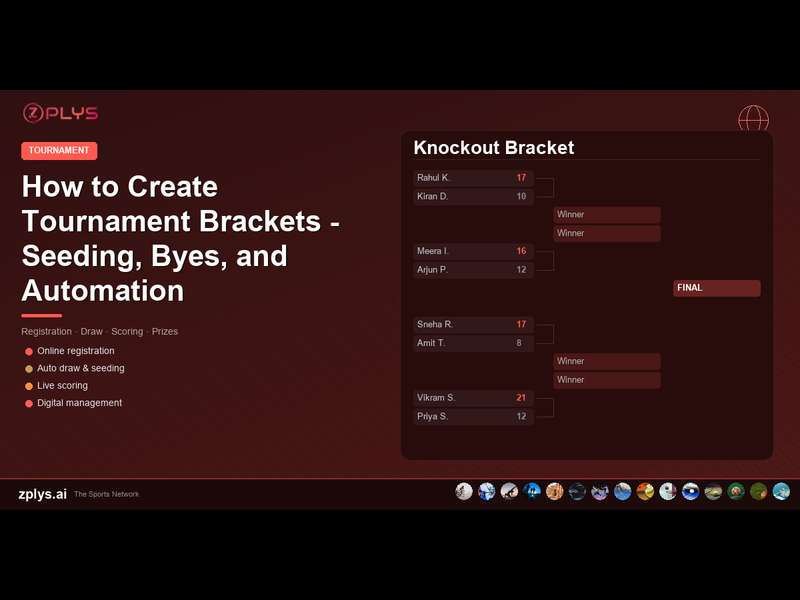
Why Brackets Matter More Than You Think
The bracket is the skeleton of a knockout tournament. It determines who plays whom, when the best players might meet, how many rounds exist, and how fair the competition feels. A poorly constructed bracket - where the two best teams meet in the first round, or where byes are distributed unevenly - undermines the entire event before a single ball is bowled or shuttlecock hit.
Yet most tournament organizers in India still create brackets manually. They write team names on paper slips, draw them from a bowl, and arrange matches on a whiteboard. This works for 8 teams. It becomes chaotic for 16. And it is genuinely impossible to do correctly for 24 or 48 entries while respecting seeding rules, bye placement, and match separation.
Understanding Bracket Sizes
Knockout brackets work cleanly with powers of 2: 4, 8, 16, 32, 64 entries. When your entry count does not match these numbers, you introduce byes to round up to the next power of 2.
Common scenarios and their bracket requirements:
- ●**12 entries:** 16-bracket with 4 byes
- ●**20 entries:** 32-bracket with 12 byes
- ●**24 entries:** 32-bracket with 8 byes
- ●**48 entries:** 64-bracket with 16 byes
The number of byes = next power of 2 minus actual entries. Simple math, but the placement of those byes is where the art lies.
Seeding Fundamentals
Seeding separates the strongest entries so they meet only in the later rounds. Without seeding, a random draw could pit the defending champion against the second-best team in round one - a quarterfinal-quality match wasted on the opening day.
Standard seeding placement for a 16-bracket:
- ●Seed 1: Top of the upper half (position 1)
- ●Seed 2: Bottom of the lower half (position 16)
- ●Seed 3 and 4: Placed in opposite quarters from seeds 1 and 2 (positions 8 and 9, or 5 and 12 depending on the convention)
- ●Seeds 5-8: Distributed across the remaining eighth-sections
The principle is simple: seeds should be as far apart in the bracket as possible. Seed 1 and seed 2 can only meet in the final. Seeds 3 and 4 can only meet the top seeds in the semifinals. This ensures the strongest matches happen at the business end of the tournament.
For a cricket tournament in, say, Jaipur with 16 teams where the organizer knows the relative strengths, seeding the top 4 teams based on past performance and placing them correctly transforms the bracket from a random lottery into a structured competition.
Bye Placement Rules
Byes are free passes through the first round, given when the number of entries is not a perfect power of 2. The rules for bye placement are precise:
- **Seeded players get byes first.** If there are 4 byes and 4 seeds, each seed gets a bye. If there are 8 byes and 4 seeds, seeds get byes first, remaining byes go to unseeded entries.
- **Byes are distributed evenly across the bracket.** In a 32-bracket with 8 byes, there should be 2 byes per quarter, not all 8 crammed into one half.
- **Byes go in the first round only.** A player with a bye advances to the second round without playing.
- **Players with byes should not face each other in the second round.** If two bye-recipients meet in round two, it means neither has played a match - resulting in a cold second-round match with no competitive warm-up.
Here is a concrete example. A badminton tournament in Hyderabad has 20 entries for men's singles. The bracket is 32, so there are 12 byes. The top 8 seeds each get a bye. The remaining 4 byes go to unseeded players, distributed evenly: one per quarter-section of the bracket.
Group Stage Plus Knockout
For tournaments with 12-24 entries, a pure knockout format means most participants play only 1-2 matches. That is a poor experience - someone travels from Nagpur to Pune for a badminton tournament and goes home after one loss? Not ideal.
The group-plus-knockout format solves this:
- Divide entries into groups of 3-4
- Play round-robin within each group (every entry plays every other entry in the group)
- Top 1-2 from each group advance to the knockout stage
For 16 entries in 4 groups of 4:
- ●Group stage: 6 matches per group x 4 groups = 24 matches, every participant plays 3 matches minimum
- ●Knockout stage: Top 2 from each group = 8 entries, 7 knockout matches
- ●Total: 31 matches, minimum 3 matches per participant
Compare this to a straight 16-bracket knockout: 15 matches, and 8 players go home after their first loss. The group stage nearly doubles the total matches but guarantees a meaningful experience for every participant.
The Seeding Controversy
Seeding is political, especially in local tournaments. The organizer of an inter-colony cricket tournament in Delhi's Dwarka knows that seeding Team A at number 1 will anger Team B's captain, who beat them last month. Club badminton tournaments in Chennai see similar dynamics - seeding based on ratings is clean, but when no ratings exist, it becomes subjective.
Three approaches to handle seeding disputes:
- ●**Ranking-based seeding:** If official rankings or ratings exist (AITA for tennis, BAI for badminton, state-level cricket rankings), use them. This is objective and defensible.
- ●**Committee-based seeding:** Form a 3-person committee (not including any participating players or their relatives) that assigns seeds based on recent results and known ability. Publish the seedings before the draw and allow 24-hour objections.
- ●**Partial seeding:** Seed only the top 2-4 entries and randomize everyone else. This prevents the worst-case scenario (top 2 meeting in round 1) without requiring subjective rankings for all entries.
Automating Bracket Creation
Creating a seeded bracket with correct bye placement for 24 entries takes an experienced organizer about 45 minutes with pen and paper. It takes an automated tool about 3 seconds.
But speed is not the main advantage. The main advantage is correctness. Manual brackets frequently have errors: a seed placed in the wrong quarter, byes clustered in one half, or a match number that creates a logistical impossibility (like two matches feeding into the same semifinal slot from the same quarter). These errors are caught only when the tournament is underway, and fixing a bracket mid-tournament is a nightmare.
On Zplys, bracket creation works by entering your participants, assigning seeds, and selecting the format (knockout, group-plus-knockout, or groups only). The system generates the draw with proper seed placement, bye distribution, and match scheduling. If you need to swap a match or adjust a seed, you can do it before publishing - and the system revalidates the entire bracket automatically.
Publishing and Sharing the Bracket
Once the bracket is created, publish it at least 24 hours before the first match. Share it as a live link rather than a static image - a live bracket that updates as matches are completed keeps participants engaged and reduces "who am I playing next?" queries by 80%. Participants check the link, see their next opponent, and show up on time. That alone makes the entire exercise of proper bracket construction worthwhile.