
Building an Auction Presentation - Data Cards and Player Stats

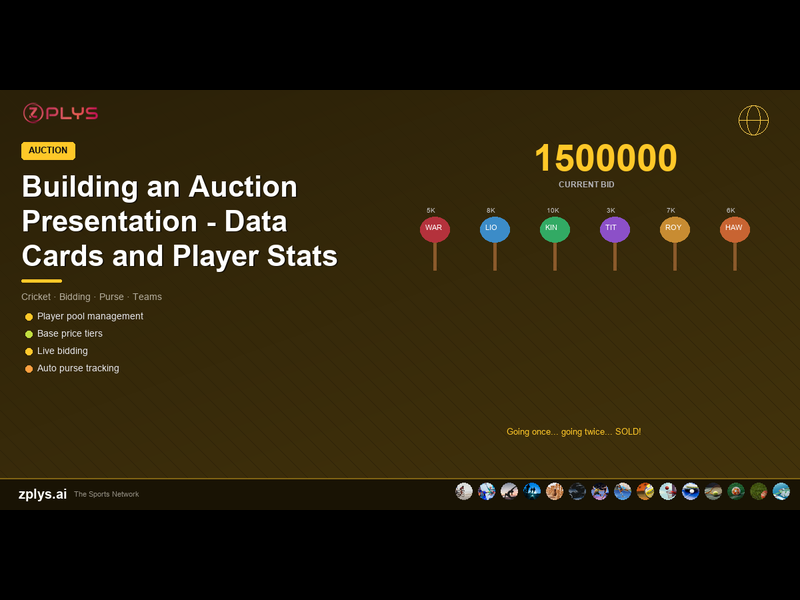
The Projector Moment
There's a moment in every well-run auction when the room shifts. The auctioneer announces a player's name, and instead of reading stats off a sheet, a professional-looking data card appears on the projector - photo, batting average, bowling figures, playing style, base price. The owners lean forward. The bidding gets sharper. That moment is the difference between a Rs 3,000 opening bid and a Rs 8,000 one.
Presentation isn't vanity in auctions. It's infrastructure. When owners can see what they're bidding on, the auction runs faster, fairer, and with fewer disputes afterward.
What Goes on a Player Data Card
A good data card answers five questions in under 10 seconds:
- **Who is this player?** - Name, photo, age, playing for (if applicable)
- **What do they do?** - Primary role (batsman, bowler, all-rounder, wicketkeeper)
- **How good are they?** - Key stats (2-4 numbers, not 20)
- **What's their track record?** - Matches played, recent form
- **What's the starting price?** - Base price clearly visible
Stat Selection by Role
Don't dump every stat you have onto the card. Pick the ones that matter for the role:
**Batsmen:**
- ●Matches played
- ●Total runs
- ●Batting average
- ●Strike rate
**Bowlers:**
- ●Matches played
- ●Wickets taken
- ●Bowling average
- ●Economy rate
**All-rounders:**
- ●Matches played
- ●Runs + Wickets (combined impact)
- ●Best batting + best bowling figures
**Wicketkeepers:**
- ●Matches played
- ●Catches + stumpings
- ●Batting average (keepers who bat are premium picks)
Where to Get the Stats
For local Indian cricket, CricHeroes is the de facto stat source. Most players in city leagues from Kolkata to Coimbatore have CricHeroes profiles with verified match data. When setting up your auction on a platform like Zplys, you can map CricHeroes profiles directly to player cards, pulling in real match stats rather than self-reported numbers.
Self-reported stats are the enemy of fair auctions. A player who claims a 35 batting average but actually averages 18 creates buyer's remorse that poisons the tournament atmosphere.
Designing the Visual Layout
You don't need a graphic designer. You need a clean layout with consistent formatting. Here's what works:
Card Layout Options
- ●**Classic Card:** Player photo on the left, stats on the right, base price at the bottom. Works on any projector.
- ●**Full-Screen Profile:** Photo as background with stats overlaid in a semi-transparent panel. Higher production value, needs a decent resolution projector.
- ●**Minimal Stats Bar:** Name and key stats in a horizontal bar at the bottom of the screen - best for live-streamed auctions where the main visual is the auctioneer camera.
Color and Branding
Pick a color scheme and stick to it. If your tournament has a logo, use it. Consistency matters more than creativity. A common approach: dark background, white text, accent color for the base price and player role badge.
Typography
Two fonts maximum. One for headings (player name, role), one for body text (stats, details). Sans-serif fonts read better on projectors - avoid anything decorative.
The Live Overlay Setup
For tournaments that stream their auction on YouTube or Facebook, a static data card isn't enough. You need a live overlay that updates as bids come in.
The OBS + Browser Source Method
Most auction overlays work via OBS (Open Broadcaster Software) using a browser source. The overlay is essentially a web page that updates in real-time as the auctioneer enters bids. Zplys provides overlay URLs that you paste into OBS as a browser source - the overlay pulls live data from the auction and renders it with your chosen theme, layout, and fonts.
The setup takes about 15 minutes:
- Install OBS on the auction laptop
- Add a browser source with the overlay URL
- Position and size it over your camera feed or background
- Test with a dummy bid before going live
What the Overlay Should Show
During bidding:
- ●Current player card (photo + stats)
- ●Current bid amount
- ●Bidding team name/logo
- ●Team's remaining budget
Between players:
- ●Teams and their current squads
- ●Budget remaining per team
- ●Players sold summary
Common Presentation Mistakes
Too Much Information
A data card with 15 stats is a spreadsheet, not a presentation. Owners need 3-4 data points to make a bidding decision. Everything else is noise.
No Photos
In a 100-player auction, names blur together. Photos are essential. Collect them during registration - a simple selfie against a plain background is fine. Tournaments that skip this step always regret it when the auctioneer says "next up, Rahul Sharma" and three owners ask "which Rahul Sharma?"
Inconsistent Formatting
When some cards have photos and others don't, or stats are formatted differently for different players, it looks unprofessional and creates an uneven playing field. Template everything.
Ignoring the Room Setup
Test your projector before auction day. A beautifully designed card that's invisible because the projector is washed out by sunlight is worse than no card at all. The Chennai Cricket Collective learned this the hard way at their 2024 auction held in an open-air restaurant at 4 PM.
The Production Value Ladder
Depending on your budget and ambition, here's what different production levels look like:
- ●**Level 1 (Rs 0):** Google Slides with player info, manually advanced. Works for 20-30 player auctions.
- ●**Level 2 (Rs 0-2,000):** Auction platform with built-in data cards and automatic player rotation. Handles 50-100+ players.
- ●**Level 3 (Rs 5,000-15,000):** OBS streaming setup with live overlays, team budget tickers, and multi-camera angles. YouTube/Facebook live stream.
- ●**Level 4 (Rs 25,000+):** Full event production with LED screens, walk-out music, and professional MC. Reserved for city-level leagues with significant entry fees.
Most local tournaments should aim for Level 2 or 3. The jump from "reading off a paper" to "showing a data card on screen" is the single biggest upgrade in auction quality, and it costs almost nothing.
The Bottom Line
A well-presented auction does three things: it helps owners make informed bids, it reduces post-auction disputes, and it makes your tournament look like it's run by people who know what they're doing. In a market where players choose between three tournaments on the same weekend, that perception matters.