
Box Cricket Auction — How to Host a Mini IPL in Your City

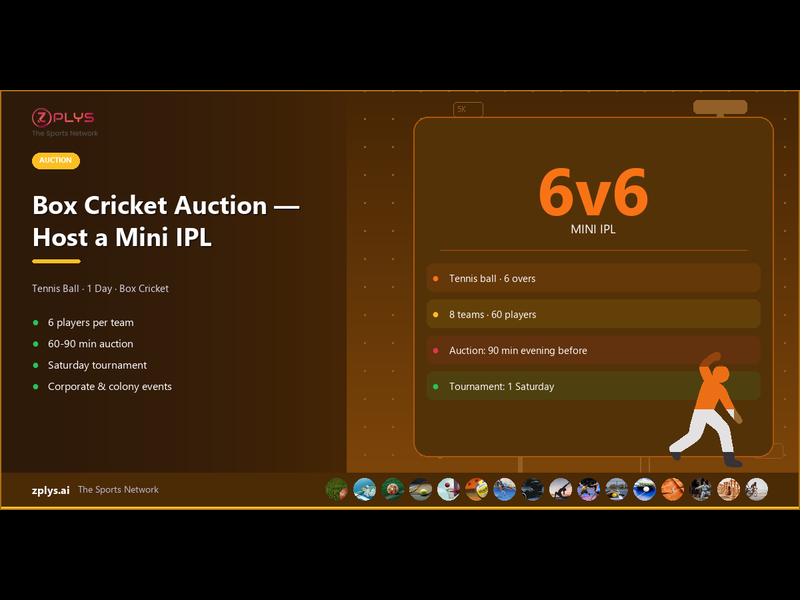
Box cricket is the great equalizer of Indian cricket. You do not need a full ground, a leather ball, or eleven players per side. A caged net, a tennis ball, and six players is all it takes. And when you add a player auction on top? You have the most exciting weekend event your city has seen in months.
Box cricket auctions have become a phenomenon in corporate parks, colleges, housing societies, and sports clubs. The format is compact (matches last 30–40 minutes), the auction is fast (60–80 players, 90 minutes), and the total event fits into a single Saturday.
The Box Cricket Format
Standard box cricket rules for auction-based tournaments:
6 players per side, 6 overs per innings
Played in a netted cage or defined area (40ft × 60ft minimum)
Tennis ball (standard or heavy)
Boundary by edges of the net (6 runs if it hits the roof net, 4 if it hits the side net on the full)
One bounce catch is out (optional but common)
Every player must bowl one over (prevents teams from having 5 specialist batters and 1 bowler)
Retired hurt at 25 runs (optional — keeps matches competitive)
These rules create balanced games where all-rounders are kings. Every player bats and bowls, which means every player matters. This is what makes the auction interesting — there are no passengers.
Setting Up the Auction
For a box cricket tournament with 8 teams:
Players in pool: 60–80 (aim for 10 per team — 6 playing, 2–4 reserves)
Purse per team: Rs 50,000 (auction currency)
Squad size: minimum 6, maximum 8
Base prices: Category A (Rs 5,000), Category B (Rs 3,000), Category C (Rs 1,500)
Sets: 3 sets — all-rounders, batters, bowlers
Auction duration: 60–90 minutes (box cricket auctions are faster — smaller squads, fewer players)
The auction doubles as the opening ceremony. Run it the evening before tournament day, or the morning of (if you have time). A 7 PM Friday evening auction followed by a Saturday tournament creates a weekend event experience.
Team Owners: Corporate and Community
In corporate settings, team owners are department heads or senior managers. Each "team" represents a department, project group, or office location. The owner's budget comes from the event fund, and the bragging rights are real — nobody wants their team eliminated in the first round.
In community settings, team owners are RWA members, local business owners, or groups of friends who pool money. The entry fee per team (Rs 5,000–15,000 for box cricket) covers the purse and contributes to the prize fund.
Name the teams creatively — Chennai Super Kings, Mumbai Indians, or original names like "IT Tower Titans" and "Finance Foxes." Team identity builds investment, and investment builds energy.
The Venue and Equipment
Box cricket venues in India: indoor sports facilities with nets, outdoor cricket cages (permanent or temporary), school gymnasiums with protective nets, and rooftop cages in urban areas.
Equipment per match: 2 bats (keep spares — tennis ball cricket breaks bats), 6 tennis balls (heavy tennis balls for better bounce), stumps or a target board (some box cricket formats use a target behind the batter instead of stumps), and a scoring tablet or phone.
For the auction: any room with a screen. A meeting room in the office, the society clubhouse, or even an outdoor setup with a portable projector works.
Day-of-Event Schedule
A typical box cricket tournament day with 8 teams:
8:00 AM — Setup and team reporting
8:30 AM — Group stage begins (2 groups of 4, round robin)
Group A, Match 1 on Court 1 + Group B, Match 1 on Court 2 (simultaneous)
Each match: 6 overs × 2 innings = 40 minutes with changeover
12 group matches total (6 per group), finished by ~12:30 PM
12:30 PM — Lunch break + semifinal draw announcement
1:30 PM — Semifinal 1 and Semifinal 2 (simultaneous on 2 courts)
2:30 PM — 3rd Place and Final (can be simultaneous or sequential)
3:30 PM — Prize distribution and closing
The entire tournament finishes in 7–8 hours. With the auction the evening before, it is a 2-event experience that players remember.
Why Box Cricket + Auction Works Better Than Other Formats
The combination works because of three factors:
Accessibility: everyone can play. You do not need to be a district-level cricketer. The 45-year-old finance manager who bowls gentle off-spin is valuable in box cricket because every player must bowl.
Strategy: the auction adds a strategic layer that pure cricket does not have. Building a balanced 6-player squad from a pool of 70 requires real thought. Do you spend big on one star all-rounder, or spread your budget across solid players?
Entertainment density: short matches (40 minutes) mean more games per hour. The auction is a show. Prize distribution is a celebration. The ratio of "exciting stuff happening" to "waiting around" is far better than a traditional tournament.
Scaling Up
Start with one event. If it works (and it will — box cricket auctions have a near-perfect satisfaction rate), run it quarterly. Build a league with points across editions. The same teams, the same rivalries, the same auction drama — but with stakes that compound over time.
A corporate box cricket league in Bangalore runs four tournaments per year. The annual champion is decided by cumulative points. The auction for each edition has become the social event of the quarter, with 200+ employees attending in person and another 300 watching the live stream.