
Batch Management and Scheduling for Sports Coaching Centres

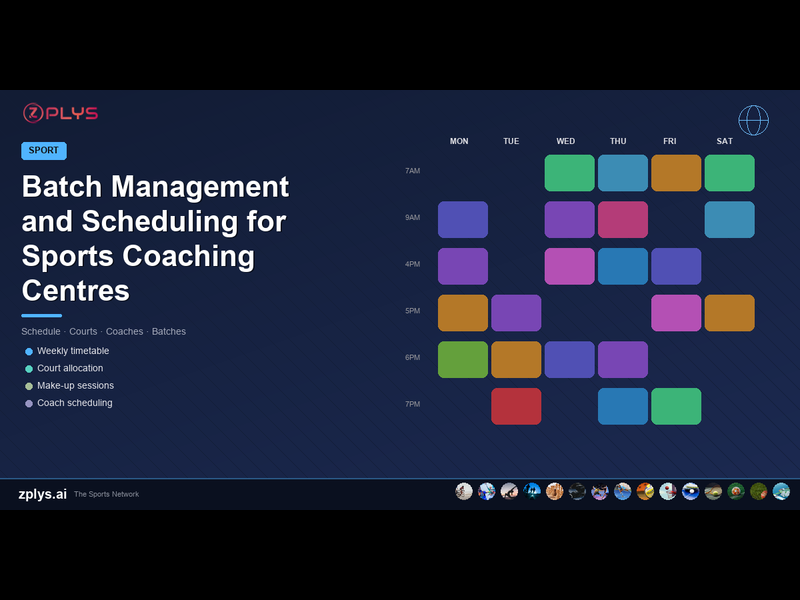
A cricket academy in Delhi had seven batches, three coaches, and two nets. On paper, it worked. In practice, coaches were double-booked on Tuesdays, the morning batch had 22 students fighting for two nets, and the 6 PM slot - the most popular time - had a waitlist while the 7:30 AM slot ran with four students.
Batch management is the unsexy operational backbone of every coaching centre. Get it right and everything flows - coaches know where to be, courts are fully utilized, students get quality time. Get it wrong and you have chaos dressed up as a schedule.
Designing Batches That Work
Start with your constraints, not your preferences:
- ●How many courts/nets/lanes do you have?
- ●How many coaches are available at each time slot?
- ●What is the maximum student-to-coach ratio for quality training? (Typically 8:1 for racket sports, 12:1 for cricket, 6:1 for swimming)
- ●What times do your target students actually want to train?
Map these constraints on a grid. You will quickly see where the bottlenecks are. The 5-7 PM window is universally the most demanded slot in India - school finishes at 3-4 PM, parents pick up kids, do homework, and drop at the academy by 5. If you have only one batch in this window, you are capping your enrollment artificially.
The Batch Types Every Academy Needs
Beginner Batches
Lower intensity, higher coach-to-student interaction. Focus on fundamentals, fun, and building habit. These are your pipeline - every competitive player started here. Keep these affordable and high-volume.
Intermediate/Regular Batches
The bulk of your enrollment. Students who have been training 3-12 months and are developing skills. Three to five sessions per week, structured drills and match play.
Advanced/Competitive Batches
Smaller groups, higher intensity, typically 5-6 sessions per week. These students enter tournaments. Pricing is premium. Keep batch sizes small - 6-8 students maximum.
Weekend-Only Batches
For working professionals and recreational players. Saturday and Sunday morning sessions. Often the easiest batch to fill and the least operationally complex.
Personal Training Slots
Block 2-3 slots per day for private coaching. These are high-revenue, low-effort sessions that also give coaches variety.
Avoiding the Common Scheduling Traps
Trap 1: Overfilling peak hours. When your 5 PM batch has a waitlist, the temptation is to squeeze in three more students. Resist. Overcrowded sessions destroy training quality and accelerate churn. Instead, open a parallel batch at the same time on a different court, or stagger times (4:30 PM and 5:30 PM).
Trap 2: Underutilizing off-peak hours. Your 7 AM and 2 PM slots are empty? Do not just hope they fill. Price them 15-20% lower than peak hours. Offer them to homeschool students, college students, or senior citizens. A yoga academy in Mysore filled their 11 AM slot entirely with retired professionals at a 20% discount - a slot that was previously dead.
Trap 3: Coach-dependent scheduling. If Batch A only works because Coach Ravi is available at 6 PM on Mondays, you have a fragile system. What happens when Ravi is sick? Cross-train coaches so that any coach can cover any batch. Document your drill plans so substitutes can walk in and run the session.
Technology for Batch Management
A spreadsheet works for one coach and three batches. Beyond that, you need scheduling software that handles:
- ●Visual timetable showing all batches, coaches, and courts on one screen
- ●Conflict detection - alerts when a coach is double-booked or a court is overallocated
- ●Student assignment - which students are in which batch, with easy transfers
- ●Make-up session tracking - students who missed sessions and need to attend alternate batches
- ●Waitlist management - automatic notification when a slot opens
Platforms like Zplys include batch scheduling as part of their academy management suite. The visual timetable alone saves hours of back-and-forth that currently happens over WhatsApp.
Measuring Batch Health
Track these numbers monthly:
- ●Court/facility utilization rate: aim for 75-85% during operating hours. Below 75% means you are paying rent for idle space. Above 85% means you have no room for growth or make-ups.
- ●Average batch fill rate: total students enrolled in a batch divided by batch capacity. Target 80-90%.
- ●Coach utilization: hours coached vs hours available. Target 70-80%. Below that, you are overstaffed. Above that, your coaches are burning out.
- ●Batch churn: students leaving each batch per month. If one batch has significantly higher churn than others, something is wrong with that specific time, coach, or mix of students.
Scaling From 3 Batches to 15
The jump from a few batches to a full schedule is where operational complexity spikes. Here is the playbook used by a multi-sport academy in Ahmedabad that grew from 40 to 350 students:
Phase 1 (40-80 students): Owner coaches all batches. Schedule is simple - 3 batches, one court. Focus on filling existing batches to 80%+ before adding new ones.
Phase 2 (80-150 students): First assistant coach hired. Add 2-3 new batches. Introduce batch tiers (beginner, intermediate). Start using scheduling software.
Phase 3 (150-250 students): Second facility or extended hours. 8-10 batches. Dedicated batch manager role (could be a senior coach). Automated reminders for batch changes and make-ups.
Phase 4 (250+ students): Multiple coaches, staggered shifts. 12-15+ batches. Coach scheduling becomes as important as student scheduling. Performance reviews tied to batch metrics.
At every phase, the rule is the same: fill existing batches before creating new ones, hire coaches before you are overwhelmed, and let software handle the complexity that your brain should not have to carry.