
Auction vs Draft — Which One Builds Better Teams?

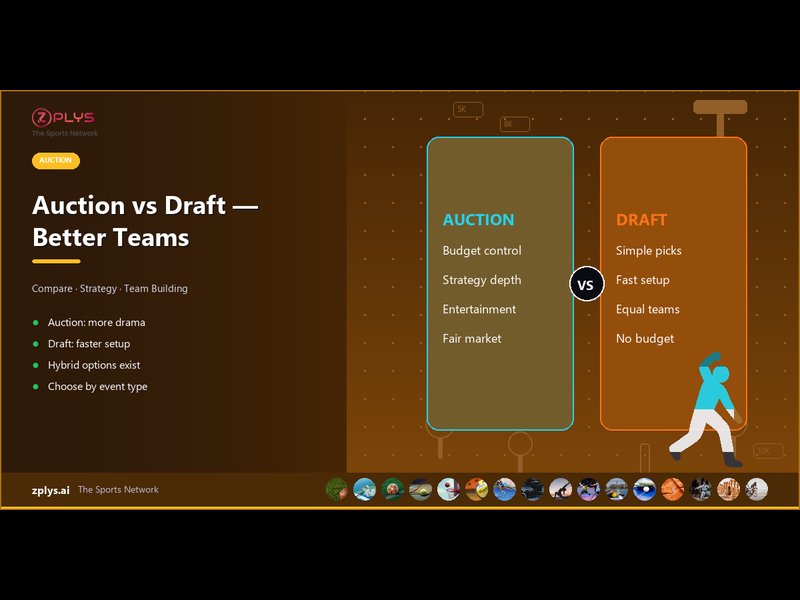
When you are organizing a team-based tournament and need to divide a player pool into balanced squads, you have two main options: an auction (players are bid on with a budget) or a draft (teams take turns picking players in sequence). Both work. Both have fans. And the one you should choose depends on what you value most.
How Each System Works
The Draft
Teams pick one player at a time in a rotating sequence. Round 1: Team 1 picks first, Team 2 second, ... Team 8 last. Round 2: the order reverses (snake draft) — Team 8 picks first, Team 1 picks last. This continues until all squads are filled.
The snake format ensures rough parity. The team picking last in round 1 picks first in round 2, compensating for their positional disadvantage.
The Auction
Each player is presented one at a time with a base price. Teams bid, increasing by fixed increments. The highest bidder wins the player, and the purchase price is deducted from their purse. Teams must manage their budget across all picks.
Team Balance: Slight Edge to Draft
Drafts produce more balanced teams by design. The snake format ensures that no team gets an overwhelming collection of top talent. The team picking eighth in round 1 gets the first pick of round 2 — they might miss the best player overall, but they get the best of what remains at two consecutive positions.
Auctions can produce imbalanced teams if an owner overspends on two star players and fills the rest of the squad with base-price picks. This is a feature, not a bug — it rewards smart budget management. But it does mean that a poorly managed team can be significantly weaker than a well-managed one.
Verdict: if team balance is your top priority and you want all teams competitive, draft is safer. If you want team identity and strategic depth, auction is better.
Player Valuation: Advantage Auction
In a draft, every player is equivalent to one pick. The first pick of round 3 is "worth" the same as the last pick of round 3, regardless of how much better one player is than another. There is no mechanism to express "I value this player three times more than that one."
In an auction, valuation is explicit. A team spending Rs 12,000 on a player is making a statement about their worth relative to the Rs 3,000 player and the Rs 8,000 player. This creates real market dynamics — undervalued players are bargains, overvalued players are traps. The auction rewards knowledge and judgement.
Entertainment Value: Auction Wins Decisively
A draft is efficient. It is also quiet. Each team makes their pick, the room nods, and the next team picks. The excitement peaks in round 1 and diminishes with each subsequent round.
An auction is theatre. The bidding wars, the strategic bluffs (bidding up a player to drain a rival's purse), the suspense of the countdown timer, the eruption when a dark horse goes for an unexpectedly high price — auctions are inherently more entertaining for participants and spectators.
If your tournament relies on the team selection event for buzz and marketing, auctions win by a wide margin.
Time Required: Draft is Faster
A draft for 8 teams × 11 players = 88 picks, at 30–60 seconds per pick, takes 45–90 minutes.
An auction for 88 players takes 2.5–4 hours because each player involves multiple bids, and the competitive bidding extends the process.
If time is limited (e.g., corporate events where you have a 2-hour window for the entire team selection), a draft fits better.
Organizer Complexity: Draft is Simpler
A draft requires minimal technology — a whiteboard and a list of available players. One person manages the pick order and crosses off selected players. No budget tracking, no bid increments, no purse calculations.
An auction requires real-time tracking of 8 team budgets, squad composition rules, bid history, and unsold player management. Without software, this is error-prone. With software (like Zplys), it is smooth but requires more setup.
When to Use Each
Choose a Draft When:
Time is limited (under 90 minutes for team selection)
Organizers do not have auction software or experience
Maximum team balance is the priority
The event is informal (friends dividing into teams for a weekend game)
Players are roughly similar in skill level
Choose an Auction When:
The team selection event is part of the tournament experience (not just logistics)
You want to create pre-tournament buzz and engagement
There is significant variation in player quality (stars and newcomers)
You plan to live stream or host the selection as a spectator event
The tournament is recurring and you want team identity to carry across editions
You want team owners to exercise real strategy, not just pick-order luck
The Hybrid: Draft with Auction Elements
Some tournaments use a hybrid approach: a draft where each team, instead of picking a player, bids on a draft position. Team owners auction for the right to pick first, second, third, etc. This adds some auction excitement while keeping the simplicity of draft-based team construction.
Another hybrid: retain 2–3 players via auction (or pre-set prices), then fill remaining slots via draft. This gives teams identity continuity while keeping the selection process quick.
The Verdict
For most Indian local tournaments — where the event is as important as the sport, where bragging rights matter, and where the organizer wants to create a memorable experience — the auction wins. It is more work to set up, but the payoff in engagement, stories, and player satisfaction makes it worth every extra minute of preparation.
A draft is perfectly fine for quick, informal team divisions. But once you have run an auction, it is hard to go back to the clipboard.